








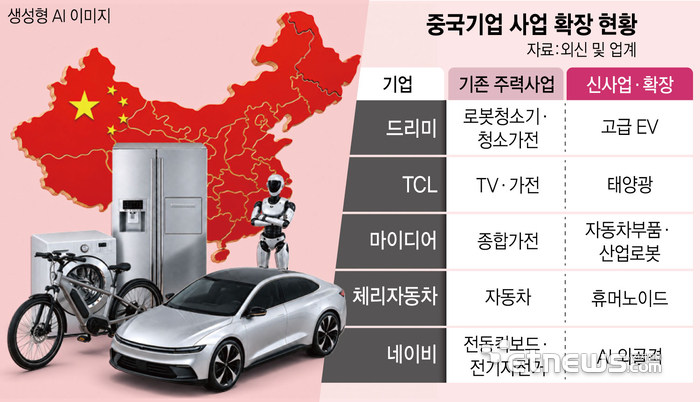
Chinese appliance makers are rapidly reshaping their businesses, shifting capital and engineering talent toward robotics, embodied AI and mobility. The moves reflect a broader strategy: test new markets quickly, then redirect resources toward sectors with the strongest commercial potential.
Dreame, best known for robot vacuums, has undertaken one of the sharpest pivots. The company has halted its luxury electric-vehicle project, including the “Rocket Car” concept it unveiled in San Francisco and at the Beijing Auto Show in April. Dreame said it would not continue the automotive project as an independent business unit and would redeploy intellectual property, technical expertise and research output across smart mobility, robotics and its broader research-and-development platform.
The EV venture once employed nearly 1,000 people. Dreame has since downsized and reassigned much of that workforce to other internal divisions. The company's recent expansion in South Korea—from robot vacuums into beauty appliances and household products—also appears to be part of this broader restructuring.
A Dreame representative said personnel, intellectual property and technologies developed during the vehicle project would be repurposed across the company.
“The technological capabilities demonstrated in the automotive project can be applied not only to robotics, but also to deliver better results in our existing cleaning business,” the representative said.
The convergence of mobility and embodied AI is becoming increasingly visible among Chinese appliance makers. Technologies developed for appliances—including motors, sensors, power electronics and AI—can be transferred to robotics. Autonomous-driving perception and control technologies, along with large-scale manufacturing capabilities from the auto industry, can also be adapted for robots.
Midea offers an early example of this strategy. After acquiring German industrial-robot maker KUKA in 2016, the appliance giant developed robotics and automation into major business lines. Rather than building finished vehicles, it has also expanded into automotive components and solutions, such as electric powertrains and thermal-management systems, applying its expertise in motors, controls and power electronics to adjacent industries.
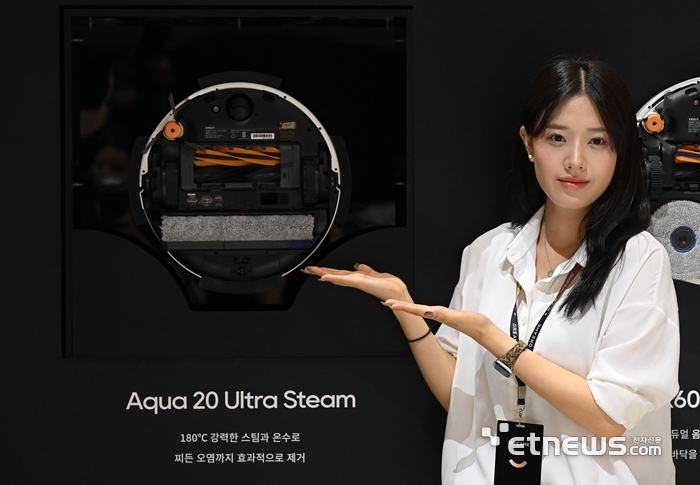
The reverse transition is also taking place, with automakers entering household robotics.
Chery Automobile's AiMOGA is one prominent example. Founded by Chery as an embodied-AI robotics brand, AiMOGA has transferred the automaker's supply-chain management, quality-control, perception and motion-control technologies into service and household robots. Its portfolio includes a 1.67-meter humanoid robot, traffic-police and healthcare-service robots, and quadruped robots.
Other companies are following similar paths. Chinese robotics company UBTECH is expanding into consumer robots, including AI-powered robotic lawn mowers. Smart-mobility company NAVEE, known for electric scooters and e-bikes, is branching into AI-based walking-assistance exoskeleton robots.
TCL, which built its business around televisions, is also broadening its portfolio beyond displays and white goods into solar power. On Aug. 24, TCL Electronics said it was considering spinning off and separately listing its photovoltaic business. The solar unit generated 21.06 billion HKD in revenue in 2025, up 63.6% from a year earlier. The proposal remains preliminary, with no formal application yet filed with the Hong Kong Stock Exchange.
The pattern illustrates how Chinese appliance makers are increasingly willing to build new business pillars outside their traditional categories once they identify a viable growth opportunity.
“Chinese appliance companies are concentrating their capabilities on new businesses such as robotics and embodied AI regardless of industry boundaries,” an industry official said. “Korean companies that expanded through similar strategies will find it difficult to retain global leadership without an equally proactive response.”
