









The government will establish a new “National Scientist and Engineer” system in which it directly identifies and honors world-class science and technology talent as national key professionals. Over the next five years, it will select 100 leader-level scientists and engineers and 1,000 next-generation talents to support their research activities and involve them in establishing national science and technology policies.
The concept is to build a nationwide talent ecosystem that prevents the outflow of excellent talent overseas and allows scientists and engineers to immerse themselves in research with pride and honor.
The Ministry of Science and ICT (MSIT) finalized the “5th Basic Plan for the Fostering and Support of Science and Technology Personnel,” containing these details, on the 31st following the deliberation and resolution of the 9th deliberative meeting of the Presidential Advisory Council on Science and Technology.
As part of this initiative, starting this year, the government will select 20 leader-level national scientists and engineers aged 55 or younger every year to provide benefits such as awarding certificates and plaques, participation in formulating national science and technology policies, invitations as main guests to major national events, global promotion of research achievements, and fast-track immigration inspection. The purpose is for the nation to show respect to top-tier science and technology professionals so that they can dedicate themselves to research with pride. The grant of 100 million KRW (or KRW100,000,000) for a National Scientist and Engineer can be used freely not only for research activities but also for participating in domestic and international academic societies, nurturing future generations, and labor costs.
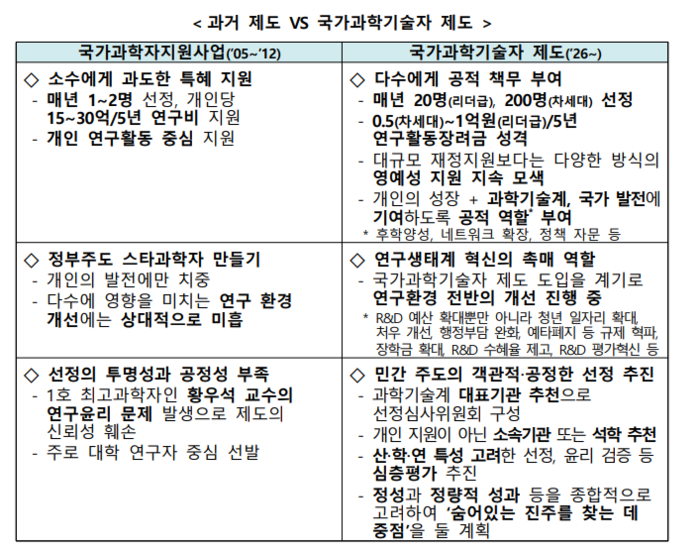
From 2005 to 2012, the government operated a “National Scientist Support Project” with a similar objective. It selected one or two individuals each year and provided up to 3 billion KRW in research funds annually, but it faced criticism that it degenerated into a government-led “star-making” exercise and was insufficient in improving the overall domestic research environment. This new National Scientist and Engineer system focuses on a public role in participating in the development of national science and technology.
President Lee Jae-myung also remarked in February this year, “By introducing the National Scientist system, we aim to open a path for people to engage in science and technology research throughout their lives and live with pride and honor.”
Starting next year, next-generation national scientists and engineers, who will be selected separately at a rate of 200 per year for five years, will also receive a 50 million KRW grant, title conferral, invitations to dialogues with the President, and preferential use of large-scale research facilities and equipment to help them unleash their potential. The evaluation for selecting National Scientists and Engineers will be handled exclusively by an independent selection committee to enhance objectivity and transparency.
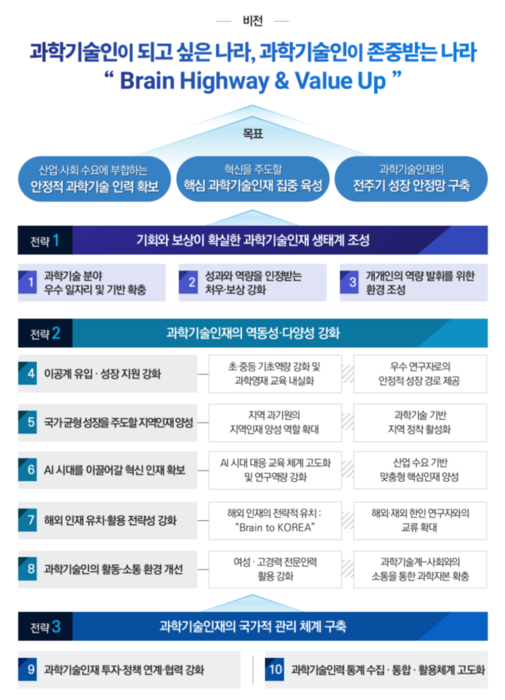
Meanwhile, the government set the vision for the 5th Basic Plan through 2030 as “A country where people want to become scientists and engineers, a country where scientists and engineers are respected,” and will execute three major strategies: securing a stable workforce in science and technology, intensively fostering core science and technology talent, and establishing a full-lifecycle growth safety net.
To this end, the government promised to expand personnel at government-funded research institutes and increase student quotas at the four major science and technology institutes. To encourage outstanding talent to take an interest in science and technology from an early age and pursue relevant career paths, the government will build “Intelligent Science Labs” in schools nationwide next year and establish three more science high schools/gifted schools affiliated with science and technology institutes beyond the current single school.
To allow science and engineering graduate students to immerse themselves in study and research without financial burden, universities supported by the “Stipend for Research and Living” (Stipend) program will be expanded to around 70 by 2030, and the scale of scholarship recipients—including the Presidential Science Scholarship—will be significantly increased from the current level of around 3,000 to around 10,000. Building artificial intelligence (AI) research infrastructure, attracting 2,000 top foreign researchers, and supporting female scientists and engineers whose careers were interrupted are also included in this plan.
MSIT will coordinate science and technology talent policies that have been dispersed across ministries and agencies to build a system where excellent science and engineering talent flows in according to the demands of industrial and research sites.
Bae Kyung-hoon, deputy prime minister and minister of science and ict, stated, “In the complex crisis of global technological hegemony competition, a low birth rate, and a shrinking school-age population, the only way for the Republic of Korea to leap forward as a leading global nation ultimately lies in 'people.'” Bae added, “This 5th Basic Plan places emphasis on establishing a full-lifecycle ecosystem where science and technology talent can feel pride and grow and thrive to their heart's content on South Korean soil.”
