








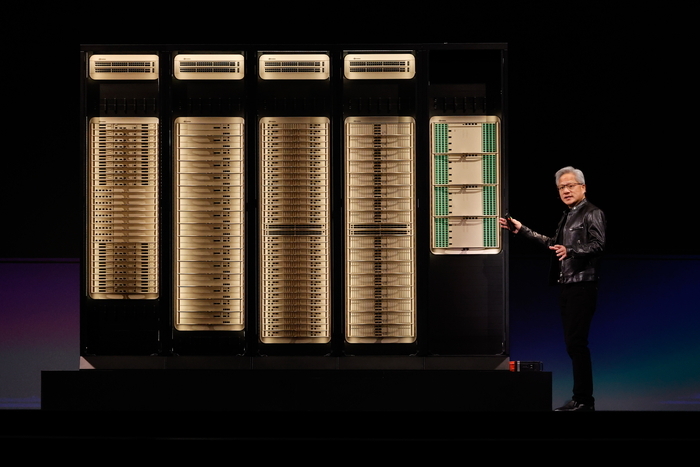
Jensen Huang, CEO of NVIDIA, declared that the “era of artificial general intelligence (AGI) has arrived” following the release of OpenAI's new model, 'GPT-6 Astra.' Investor sentiment, which had been shaken by peak AI concerns, rebounded on the announcement of Astra.
On the 7th (local time), Huang mentioned the four-year journey from ChatGPT's early reasoning models to Astra via his social media X, stating, “AGI has finally emerged.”
He revealed that OpenAI used over 100,000 of NVIDIA's Grace Blackwell (GB) NVL72 chips to train Astra and announced plans to deploy an additional 400,000 GPUs in the future.
The AGI he referenced refers to an AI capable of learning and performing most human intellectual tasks without being limited to specific domains. Astra, unveiled on the 3rd, has been praised for its significantly improved ability to directly manipulate human-computer environments and handle multi-step complex tasks. Notably, it scored 99.9% on the ARC-AGI-3 benchmark, which measures new problem-solving capabilities—a massive leap from its predecessor's 7.9%.
OpenAI President Greg Brockman added, “People will look back on Astra as an early stage,” and welcomed the arrival of the AGI era.
However, debates over AGI evaluation criteria persist. Many in the industry and academia argue that the definition of AGI itself remains unresolved, and critics highlight current AI models' limitations, such as their inability to fully understand the real world or tendency to produce incorrect answers.
Given Huang's repeated claims in March and last month's earnings call that “AGI has already been achieved,” some view this declaration as more of a personal assessment than a verified technical milestone. Some interpret his remarks as an attempt to emphasize NVIDIA GPUs' pivotal role in cutting-edge AI development.
Nonetheless, the market reacted fervently. The KOSPI index surged 4.61% to 6,995.39, marking its highest level in about six weeks. Analysts attribute the revival of investor sentiment shaken by peak AI concerns to the Astra announcement. Notably, large-cap stocks in AI hardware sectors—such as semiconductors, power, and substrates—led the rally. Samsung Electronics and SK Hynix jumped 5.7% and 8.3%, respectively.
The growing demand for AI infrastructure is directly reflected in NVIDIA's performance. In the latest quarter, approximately 92% of NVIDIA's total revenue of $96.2 billion—$89 billion—came from its data center business.
