








Tongcheng Travel Officially Launches 'HopeGoo'
Responding to Surging China Travel Demand
Domestic Industry Spooked by Offensive Rush
China's largest online travel agency (OTA), Tongcheng Travel, is directly targeting the growing demand among South Koreans for travel to China. With Alibaba Group's Fliggy entering the Korean market last year and Chinese Trip.com rising to the top position in number of South Korean users, another giant Chinese company is joining the competition in the Korean OTA market.
Experts point out that regulatory reverse discrimination must be resolved so that global OTAs and domestic operators can compete in a fair environment, alongside updating consumer protection systems such as dispute resolution and refunds.
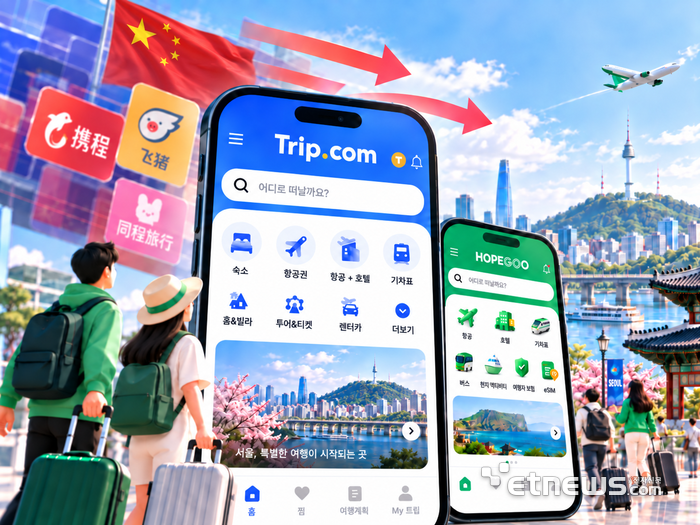
According to the industry on the 16th, Tongcheng Travel officially launched the Korean service of its global OTA brand 'HopeGoo' last month. Tongcheng Travel is considered China's largest OTA. Last year's revenue reached 19.396 billion yuan (approximately KRW3.93 trillion), an 11.9% increase year-on-year. As of the end of June this year, annual paying users reached 253.9m, and cumulative travel service usage reached 2,044.3m cases.
Tongcheng Travel has so far targeted Chinese demand for travel to South Korea. To this end, it conducted South Korea travel marketing with Gyeonggi Tourism Organization last year and expanded its Korean accommodation distribution network in collaboration with AllMyTour.
By launching its service in South Korea this time, it expands its target audience to South Koreans planning to travel to China. It supports Korean and linked major domestic easy payment services such as Kakao Pay, Naver Pay, and Toss Pay to enhance user convenience. It provides one-stop services for traveling to China, including flight tickets, hotels, tourist attraction entry tickets, eSIMs, and high-speed rail tickets.
This move targets the increasing trend in South Koreans' demand to visit China. According to immigration statistics from the Ministry of Justice, South Koreans visiting China surged from 1.07m in 2023 to 2.31m in 2024 and 3.16m in 2025.
The domestic industry sees Tongcheng Travel's short-term market impact as limited, but expects it to quickly grow its presence through a large-scale capital offensive.
In fact, Tongcheng Travel is earnest about investing to expand its influence in the Korean market. It incorporated Sunland Air Travel Service, a domestic air travel specialist established in 1997, as a subsidiary this year to secure a domestic airline ticket distribution network. It is also building local Korean organization structures one after another. In April, it appointed a general manager (GM) to oversee HopeGoo's Korea service. It has begun hiring local personnel to formulate service strategies by analyzing major OTAs such as NOL (formerly Yanolja), MyRealTrip, Tripdotcom, and Agoda, and to plan joint marketing with Naver and Kakao.
Trip.com, which reached number one in the number of South Korean users, growing with unstoppable force since its entry in 2017, is also a reason the domestic industry is nervous. According to Mobile Index, Trip.com's monthly active users (MAU) as of June this year took the top position at 4.77m and continues to grow to 5.54m in July and 5.91m in August.
Experts stress that resolving 'reverse discrimination'—where global OTAs, unlike domestic companies, do not comply with regulations—and the lack of consumer protection policies are urgent issues.
Shin Huck-soo, professor in the Department of Tourism at Hanyang University, pointed out, “Foreign companies carry out business activities without faithfully complying with domestic regulations and apply policies disadvantageous to South Korean consumers, such as following their own country's consumer compensation systems.” He added and emphasized, “Efforts are needed to create a fair competitive environment between domestic and foreign companies and to strengthen consumer protection mechanisms for those using global OTAs.”
