








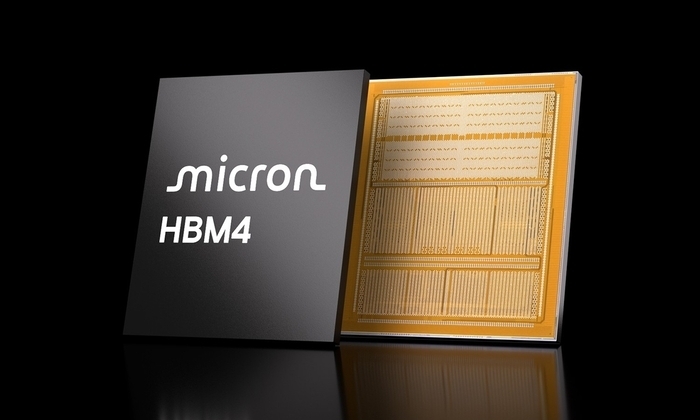
Micron Technology of the U.S. will double its High Bandwidth Memory (HBM) production capacity compared to last year. The company is making aggressive capital investments through the end of the year to enhance its supply capability for 12-layer HBM4, the latest generation of HBM. This is an attempt to increase market share by boosting its HBM production capacity, which currently lags behind Samsung Electronics and SK Hynix.
According to industry sources on September 3, Micron plans to add up to 60,000 wafers per month in HBM production capacity (based on wafer input) by the end of this year. Last year, Micron's HBM output stood at around 40,000 to 50,000 wafers per month, meaning this year's net increase will exceed that level.
An industry source familiar with the matter stated, “Micron is making large-scale facility investments to rapidly boost its HBM4 production capacity,” adding, “By the end of this year, it will secure a total HBM production capacity of approximately 100,000 wafers per month.”
To secure such production capacity, Micron is increasing purchase orders (POs) to multiple HBM manufacturing equipment suppliers. Its HBM production hubs are fabs in Taiwan and Singapore, where continuous equipment delivery is reportedly taking place.
The proportion of 12-layer HBM4 is expected to rise significantly. Currently, 12-layer HBM3E accounts for most of Micron's HBM production volume. Although 12-layer HBM4 accounted for only 20% to 30% of total output as of early this year, that figure is reported to reach up to 50% by the end of the year.
The 12-layer HBM4 will be installed in 'Vera Rubin', the latest AI accelerator from Nvidia, the world's largest artificial intelligence (AI) semiconductor company. Micron began mass production of 12-layer HBM4 products in the second quarter of this year.
Earlier, Sanjay Mehrotra, CEO of Micron, stated during the fiscal third-quarter 2026 earnings call in June that “the mass-production ramp-up for 12-layer HBM4 is progressing about twice as fast as that of 12-layer HBM3E,” and revealed that “cumulative shipment revenue for HBM4 has surpassed $1 billion.”
Although Micron is one of the world's top three HBM manufacturers, its production capacity falls short of Samsung Electronics and SK Hynix. The industry estimates that the HBM production capacity of Samsung Electronics and SK Hynix is 3 to 4 times higher than Micron's (about 150,000 to 200,000 wafers per month for each company). From Micron's perspective, unless it catches up with the production capacity of both companies, it will be difficult to break out of its status as a perpetual third player.
If Micron meets its HBM capacity targets this year, the production gap with Samsung Electronics and SK Hynix could be narrowed to half of its previous level.
Micron's expansion of HBM production capacity is also proof of robust demand for AI memory. As AI semiconductor makers led by Nvidia actively seek HBM, supply is still unable to keep pace with demand. In this environment, maximizing HBM profitability requires the ability to supply—namely, production capacity.
Micron is currently investing in HBM production facilities across the globe. Outside the U.S., HBM packaging is taking place at the Tongluo fab in Taiwan and the Woodlands fab in Singapore, while investments are also being prepared for its Hiroshima fab in Japan.
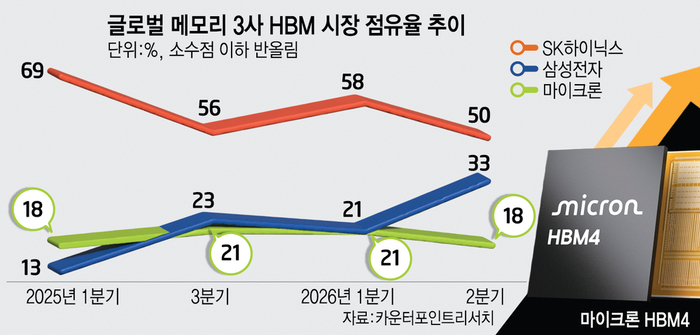
According to Counterpoint Research, SK Hynix ranked first in the global HBM market in the second quarter of this year with a 50% market share. Samsung Electronics held 32%, while Micron accounted for 18%.
