








KT's global submarine cable project orders have increased more than sixfold within a year. The company's preemptive strategy to secure capacity in key submarine cable segments with high traffic—such as Japan, Singapore, and Hong Kong—has proven effective. By continuously expanding its own submarine cable infrastructure and global network, KT aims to accelerate its transformation into a comprehensive all-space network infrastructure company spanning land, sea, and air in the AI era.
According to industry sources on the 28th, KT's submarine cable project orders connecting Asia-Asia and Asia-America this year amounted to 14.55 billion KRW, marking a 6.2-fold surge compared to the entire previous year's total of 2.34 billion KRW.
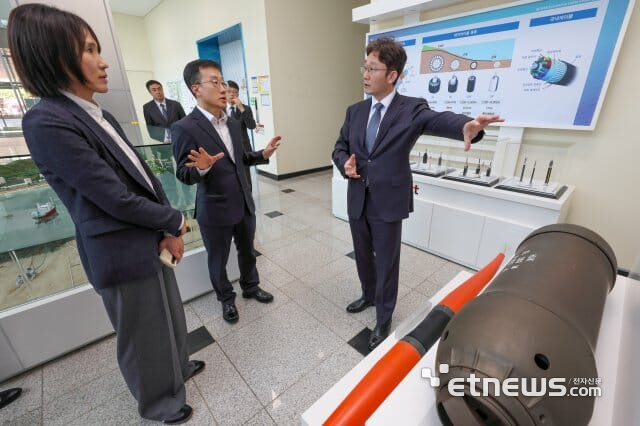
Submarine cables are divided into two categories: those where companies directly build networks to provide communication services, and those where companies purchase a certain capacity from cables built by other operators and supply it to other businesses.
Previously, KT only supplied submarine cables originating from South Korea, such as the 'Korea-Japan' segment. However, starting last year, KT has actively expanded into purchasing and supplying overseas segments, turning this into a new business opportunity.
Currently, KT has secured global submarine cable capacities in the following segments: △Hong Kong-Singapore △Singapore-Japan △Japan-U.S. These routes are often called 'AI network hubs' due to their concentrated traffic, resulting in high market demand. In fact, the traffic volume in the Singapore-Japan-U.S. segment reaches 274 terabits per second (Tbps), which is over 10 times higher than the Korea-Asia segment (27 Tbps).
To proactively secure submarine cable capacities in key Asian routes, KT has formed partnerships with telecom operators such as Indonesia Telin, Malaysia TM, and Australia Telstra. Based on these collaborations, KT has acquired 4.4 Tbps of capacity this year alone, securing approximately 11 times the total capacity it had last year.

As demand for AIDC and cloud services surges, numerous customers are lining up to purchase submarine cable capacity secured by KT. This year's order volume has already surpassed six times last year's total (2.34 billion KRW), growing rapidly. Although absolute sales remain modest, evaluations highlight high growth potential given that this year marks the business's inaugural year and over 90% of global internet traffic relies on submarine cables, with demand surging.
KT plans to invest 1 trillion KRW by 2031 to secure 90 Tbps of self-owned submarine cable capacity while strengthening a dual strategy of continuously purchasing and servicing submarine cable capacity in key global segments in the medium to short term. Based on this, KT aims to grow submarine cables into a new B2B revenue source while completing a “triangular network infrastructure across land, sea, and air” by integrating ground (AIDC), space (low-orbit satellite communications), and submarine capabilities.
A KT representative stated, “Our strength lies in the ability to comprehensively provide and operate integrated solutions from overseas hubs to submarine cables, landing stations, domestic dedicated networks, AIDC, and AI edge.” They added, “We will strive to lead the submarine cable market in line with expanding AIDC demand.”
