






Micron Technology has broken its all-time quarterly earnings record once again, driven by expanding demand for memory fueled by artificial intelligence (AI). With memory demand continuing centered on AI data centers, the company projected that performance growth will persist into next year.
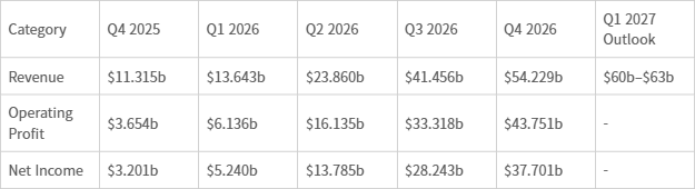
According to fiscal fourth-quarter 2026 (June-August) results disclosed by Micron on the 30th (local time), revenue and operating profit surged approximately 4.8 times and 12 times, respectively, year-over-year.
Revenue reached $54.229 billion, up 379% compared to the same period last year ($11.315 billion). This marks the sixth consecutive quarter of record-breaking performance since the third quarter of 2025. It also far surpassed the market forecast of $51.07 billion compiled by the London Stock Exchange Group (LSEG).
During the same period, operating profit soared to $43.751 billion, about 12 times higher than the previous year ($3.654 billion).
What drove the earnings growth was unquestionably memory demand for AI data centers. Revenue for the Cloud Memory business unit, which includes high bandwidth memory (HBM) sales, and the Core Data Center business unit recorded $16.3 billion and $18 billion, respectively. These two business units alone accounted for more than 60% of total revenue.
The company also expressed confidence in its financial outlook for next year. Micron presented its revenue guidance for the first quarter of fiscal 2027 at $60 billion to $63 billion. This exceeds the market expectation (approximately $57 billion).
Sanjay Mehrotra, CEO at Micron, predicted during the earnings call that “industry demand has strengthened further since the last earnings report, and the memory and storage supply and demand situation in fiscal 2027 and fiscal 2028 will be much tighter than in 2026.”
He added, “Despite robust demand trends—including new upside requests from customers—and plans for additional DRAM cleanroom space, there is no visibility into when supply and demand will regain balance.”
In particular, HBM demand was cited as a major factor exacerbating the supply shortage. Mehrotra presented as evidence the expectation that industry HBM bit shipments will grow faster than traditional DRAM through 2028, along with the fact that most of next year's HBM volume is already contracted with customers. Contract prices have also risen significantly year-over-year, he explained.
Earnings visibility is also rising through long-term supply agreements. To date, the company has signed 26 Strategic Customer Agreements (SCAs), with customer commitment scale reaching $32 billion. This is a significant expansion from the 16 agreements and $22 billion reported during the third-quarter earnings announcement.
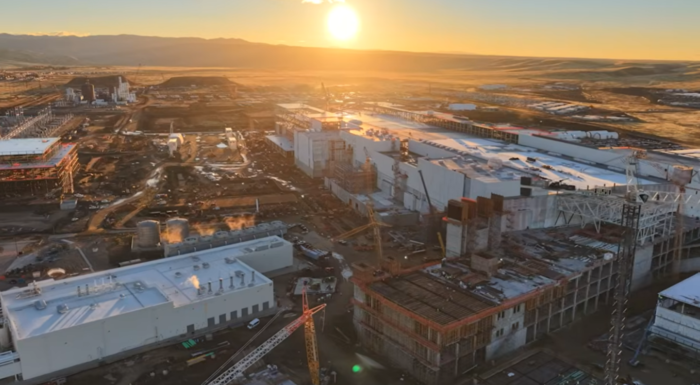
To respond to medium- to long-term demand, production capacity is also being expanded. The ID1 fab in Idaho, U.S., is scheduled to begin wafer production in mid-2027, and the ID2 fab in late 2028. The new fab in New York recently entered the groundbreaking phase, targeting initial wafer production in early 2030.
The company expected that future demand for AI memory will expand beyond data centers to 'Physical AI,' such as autonomous vehicles and humanoid robots.
“Increasingly complex systems require much higher performance and more power-efficient memory and storage to operate in real time,” Mehrotra said. “Humanoid robots are also expected to require levels of memory and storage similar to those of autonomous vehicles.”