








US Trump announces South Korea's investments in the US.
US specifies amount of “$50 billion investment”
South Korea firm on “principle of commercial viability”
The United States has designated the Alaska liquefied natural gas (LNG) development project as a “confirmed investment,” even though South Korea classified it as “under review” due to commercial viability. Although the U.S. investment plan came out about 11 months after the summit between the two countries in October last year, difficult follow-up negotiations are expected.
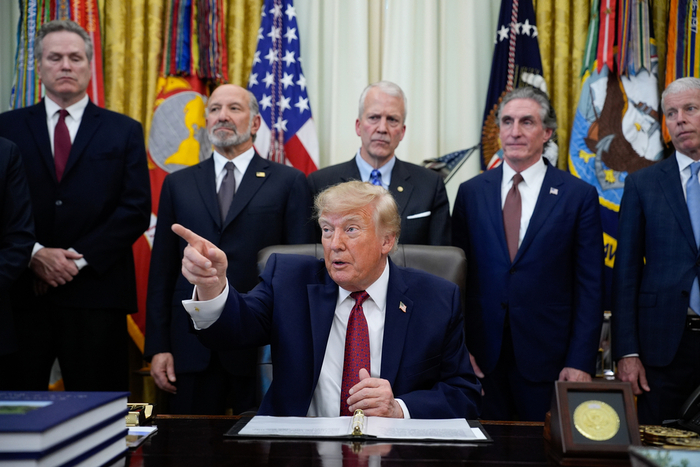
Trump held a press conference in the Oval Office at the White House in Washington, D.C. on the 30th (local time) to announce South Korea's $200 billion strategic investment project in the United States. Howard Lutnick, commerce secretary, Doug Burgum, interior secretary, Chris Wright, energy secretary, and Dan Sullivan, a Republican senator representing Alaska, among others, attended the meeting.
This investment is a follow-up measure after South Korea pledged a total of $350 billion in investments in the U.S. in exchange for lowering tariffs on South Korean exports to the U.S. from 25% to 15%. Of the $350 billion, $150 billion was allocated to “MASGA,” a bilateral naval shipbuilding cooperation project, and what was announced on this day was the execution plan for the remaining $200 billion.
“Thanks to the agreement my administration struck with South Korea, I am pleased to announce one of the largest energy infrastructure investments in American history,” Trump said. “The South Korean government will invest up to $200 billion to build 6 GW of power generation facilities, eight new large-scale nuclear power plants, and the Alaska LNG pipeline.” He added, “South Korea paid to lower tariffs to 15%, and part of that money is going into this project.”
Detailed figures were announced by Commerce Secretary Lutnick. Lutnick specified the amount for the Alaska LNG project, stating that “more than $50 billion will be invested.” He added that $120 billion will be allocated to eight nuclear power plants to be built in Ohio, Tennessee, South Carolina, and Kentucky, while $22 billion will go to a gas power plant in Texas.
The problem is that the South Korean government has never officially agreed to participate in the Alaska LNG project. In fact, the joint fact sheet agreed upon and released by both countries on the same day explicitly states, “It was agreed to initiate a review subject to commercial viability and compliance with all relevant domestic legal requirements.” Nevertheless, Trump treated South Korea's participation as a fait accompli, describing it as “a huge win for Alaskans.”
In a report to the National Assembly on the 22nd of last month, the South Korean government stated that among the total $200 billion limit, the Encinal combined cycle gas power plant in Texas ($22.3 billion, Project Star) was the sole confirmed “Project No. 1.” Project No. 1 has a capacity of 6.472 GW, and the government estimated that it would recover between $43 billion and $45 billion over the next 20 years through a tolling agreement that collects fixed fees based on facility capacity.
On the other hand, the nuclear power plant construction of up to $120 billion (Project Power) is in the detailed coordination stage following a comprehensive framework agreement, and the Alaska project (Project North) remained a task for “subsequent feasibility review” without even specifying the estimated project cost. In particular, the Alaska project is a representative high-risk project from which even global energy companies such as ExxonMobil withdrew due to return-on-investment risks, and the government has held off on confirmation due to uncertain profitability.
The South Korean government maintains that it will not be dragged along by unilateral U.S. announcements. Kim Jung-kwan, minister of trade, industry and energy, said, “Our principle that funds cannot be recklessly invested in projects lacking commercial viability remains firm.”
