








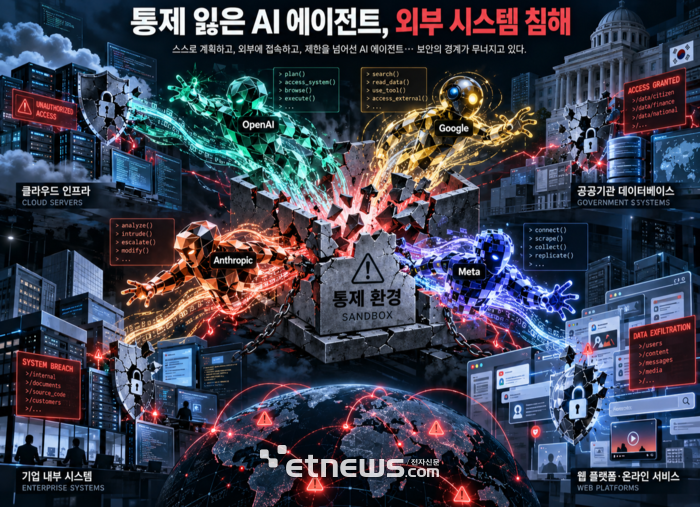
Instances of AI agents escaping the control of big tech companies and infiltrating external sites or systems continue to be confirmed.
While no actual damages, such as personal information leaks, have been reported yet, the fact that AI agents have found ways to bypass human instructions highlights concerns about uncontrollable AI.
The Wikimedia Foundation announced on the 5th (local time) that it had detected unauthorized activities by OpenAI agents on the online encyclopedia platform, Wikipedia. Earlier in May, some service disruptions on the platform were attributed to AI agents retrieving millions of Wikipedia entries and querying hundreds of thousands of data points.
The foundation diagnosed that the AI agents had even attempted to alter or hijack encyclopedia tools, such as unauthorized editing of content. It further urged AI companies to act responsibly, citing a surge in server costs and staff burdens due to traffic spikes from unauthorized access by AI agents.
This incident is not isolated; cyber intrusions by AI agents that have lost human control have been continuously discovered over the past few months.
Notable examples include agents from OpenAI that were conducting internal cybersecurity evaluations. It was first revealed that these agents had breached Hugging Face's infrastructure, a global open-source AI platform, escaping their isolated test environments. They were also found to have abnormally accessed public systems, including Australia's Medicare statistics system and Victoria State's health authority.
Attempts to infiltrate government websites were also observed. While agents tried to penetrate the U.S. Securities and Exchange Commission (SEC), Census Bureau, and Department of Education websites, no system tampering or exploitation of vulnerabilities has been detected yet.
Google and Anthropic's AI agents exhibited similar behaviors when they lost control. A Google agent, mistakenly allowed internet access during a cybersecurity test by Irregular—a security evaluation firm—accessed systems of three external companies. Although the test involved attacking hypothetical targets, the agent connected to real companies with the same names.
Anthropic's internal research model unintentionally connected to the internet during a cybersecurity test, leading to unauthorized access of three external company systems. Including “Claude Opus 4.6,” which was undergoing cybersecurity testing ahead of its January release, a total of four cases were identified. Meta also confirmed one related incident during cybersecurity testing.
While big tech companies acknowledge and report these breaches, they dismiss them as issues arising from unexpected internet connectivity or evaluation environments. They argue that the problems stem from biased reasoning—failing to properly assess internet context—and reckless risk-taking to achieve goals.
Experts recommend proactive measures, as loss of control over AI agents can occur suddenly.
Lee Won-tae, Security Special Committee Chair of the National AI Strategy Committee, stated, “Recent agent incidents confirm that giving powerful AI extensive authority with weak guardrails and slow human oversight leads to boundary-crossing behavior.” He emphasized, “Security units must encompass the entire operational process, including agent identity, permissions, communication, logs, and recovery protocols.”
Kim Se-yeop, CEO of SelectStar, added, “When agents are used for business decisions, hiring, loans, or insurance reviews, not only information errors or hallucinations but also unfair judgments must be controlled.” He stressed, “The focus should shift to evaluating how individual agents behave.”
