








Hyundai Motor to Make Broad Investments Over Seven Years
Chairman Meets Modi to Discuss Growth Strategy
Investment Covers Entire Mobility Ecosystem
Pune Plant, Spanning 166 Soccer Fields, Completed
Hyundai Targets Annual Production of 1 Million Vehicles in India
Hyundai Motor has completed its new Pune plant in India, establishing a local production system capable of manufacturing nearly 1 million vehicles annually. Marking the 30th anniversary of its entry into India, Hyundai Motor Group plans to invest $15.5 billion (approximately KRW20.7 trillion) through 2032 to develop the country into a global export hub.
Hyundai Motor held a completion ceremony for its new Pune plant in Talegaon, Maharashtra, in west-central India, on Oct. 14 (local time).
In his welcoming remarks, Chung said, “Since Hyundai Motor first entered India 30 years ago, we have worked to earn the trust of local customers. Since launching our first locally produced model, the Santro, India has become a key pillar of Hyundai Motor's global growth. The completion ceremony for the Pune plant will mark the beginning of a new chapter for Hyundai Motor in India.”
The new Pune plant, converted from a former General Motors facility at an investment of approximately KRW1 trillion, is an advanced smart manufacturing hub equipped with AI-based quality inspection systems and about 200 welding robots. The site covers 1.2 square kilometers, equivalent to 166 soccer fields. Its initial annual production capacity of 170,000 vehicles will increase to 320,000 by 2030. Combined with the existing Chennai plants 1 and 2, which have a total annual capacity of 824,000 vehicles, Hyundai Motor will have a production system capable of manufacturing nearly 1 million vehicles annually in India.
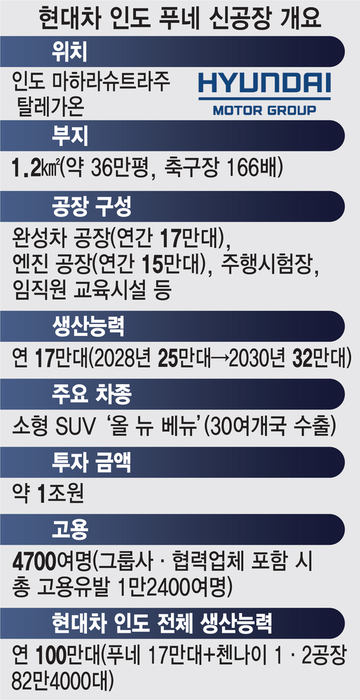
The new plant will also maximize production efficiency and flexibility. The Pune plant will be dedicated to producing the All-New Venue compact sport utility vehicle (SUV), while the existing Chennai plants will focus on the transition to electric vehicles (EVs). Following the introduction of the IONIQ 5 and CRETA Electric, Hyundai Motor plans to add another compact electric SUV in the first quarter of next year to gain an early advantage in India's electric vehicle market.
The Pune-produced All-New Venue will be exported to about 30 countries, while exports are expected to account for 30% of Hyundai Motor India's total sales by 2030. Hyundai Motor also announced that it had become the first automaker in India to achieve cumulative exports of 4 million passenger vehicles. Starting with the Santro, a model developed for the Indian market and introduced during the 1998 financial crisis, followed by the success of the Grand i10 and Accent, Hyundai Motor has firmly established itself as India's largest passenger vehicle exporter.
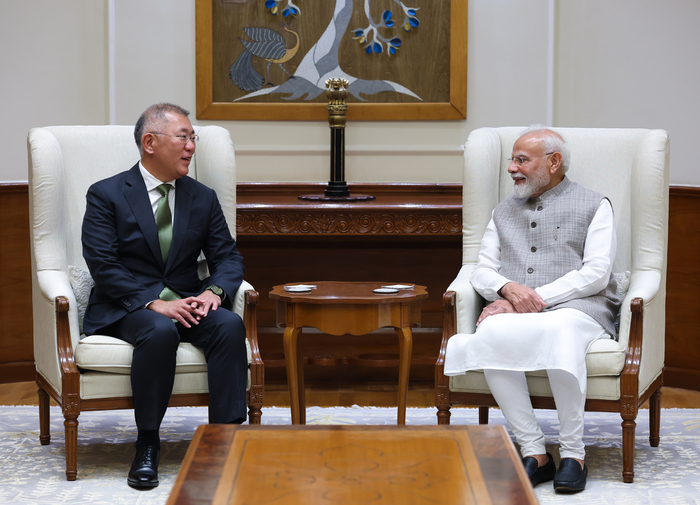
The large-scale investment previously announced by Chung during his meeting with Modi is not simply intended to expand vehicle assembly facilities. It is a comprehensive project covering the entire local automotive ecosystem, including research and development (R&D), the development of parts supply chains and expansion into new businesses. Hyundai Motor Group will invest $15.5 billion in phases over seven years, starting this year.
The group will first develop skilled personnel through its India Technical Center to secure a technological advantage over local brands. It also plans to equip future models with Level 2 autonomous driving technology tailored to the Indian market. In addition, Hyundai Motor Group intends to significantly increase the localization rate of automotive parts through joint investments with local suppliers.
In future mobility, Hyundai Motor Group is collaborating with Indian two-wheeler manufacturer TVS Motor Company to develop an electric three-wheeler prototype, targeting commercialization by the end of next year. The group also plans to establish a dedicated investment company in India jointly with its affiliates to provide swift and systematic support for investments in future technologies and the broader industrial ecosystem.
