








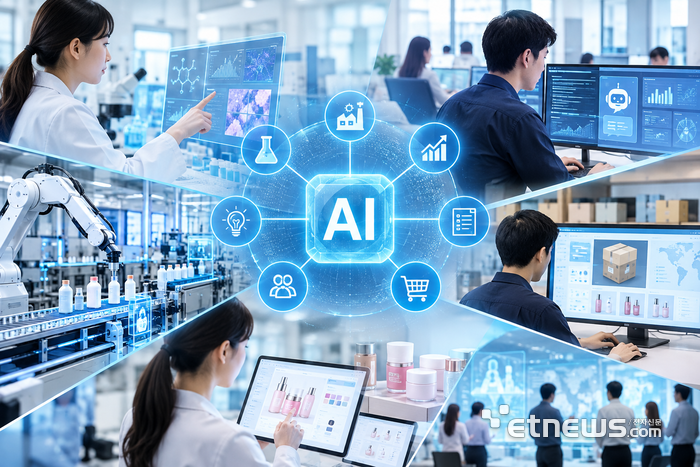
Kolmar Korea is accelerating its companywide artificial intelligence transformation (AX) by introducing an in-house AI agent platform. The company aims to establish a comprehensive AI system by expanding its use beyond manufacturing and production sites to all areas of business, including research, sales and planning.
According to industry sources on Oct. 13, Kolmar Group has established an internal platform that allows employees to build AI agents tailored to their specific tasks. Even employees without coding experience can create their own AI assistants by giving instructions to AI or combining necessary functions like building blocks. Rather than relying solely on AI tools developed by specific departments for companywide use, the platform enables employees working directly in business operations to identify ways to use AI and apply them to their tasks.
Examples include a “research assistant” specializing in analyzing academic papers and extracting data, and a “document assistant” used to prepare reports and proposals. AI has also been introduced into human resources operations. When an applicant's resume is entered, the system classifies the candidate's experience and capabilities according to internal criteria and even generates written evaluations. If additional evaluation criteria are introduced, such as “award extra points for external activities,” the system can reassess the candidate and produce results based on the revised criteria.
Kolmar Group's expansion of AI across the company is seen as an effort to strengthen the competitiveness of its original development manufacturing (ODM) business. Because ODM companies must quickly develop and manufacture products according to customer requirements, it is important to accelerate not only manufacturing but also research and development, product planning, sales and other operations related to customer service. Accordingly, Kolmar is focusing on making AI an everyday workplace tool alongside the automation of production facilities.
AI is also being applied to research and development and sales operations. At its research laboratories, Kolmar uses AI to automate reviews of cosmetic ingredients, prepare export licensing and approval documents, and predict sun protection factor (SPF) ratings. The company is also building a database to systematically collect and analyze data on cosmetic ingredients and materials.
In sales, employees use AI assistants to automatically collect and enter customer orders. Kolmar has also developed a system that uses AI to classify hundreds of thousands of academic papers by topic, summarize key findings and generate research reports. Tasks involving literature searches and report preparation that previously took about 12 hours can now be completed in approximately 30 minutes.
Kolmar Korea is also advancing its AI transformation at manufacturing sites. The company was selected as the only cosmetics company to lead a project under the AI Factory Alliance and is developing an autonomous manufacturing system that supports high-mix, low-volume production. The system uses AI to predict product properties, including viscosity and spreadability, assess the likelihood of products failing to meet specifications, and adjust production conditions accordingly. The company is also automating microbial identification and classification, conformity assessments, sampling and material transfer using AI and intelligent robots. Going forward, Kolmar plans to combine robotics and AI to analyze test data and optimize manufacturing environments.
Kolmar Group plans to accelerate practical AI transformation by enabling employees to use AI directly in their work. The group has also established a system to identify employees' AI application ideas and expand successful initiatives across the company. Approximately 200 ideas were submitted to the “AI Challenge Lab,” launched last year to encourage employees and departments to propose ways to use AI. Projects with strong potential for effectiveness and scalability are currently being selected for a fast-track program, in which employees and developers work together to further refine them. The group also plans to launch a companywide AI portal later this year to share proven AI use cases.
“We are establishing AI not as an experimental technology used by a limited number of departments, but as a common workplace tool available to all employees,” a Kolmar Group official said. “We will continue expanding the use of AI based on ideas from employees working directly in business operations and the expertise of specialized personnel.”
