




A research team at POSTECH has developed a hydrogel electrolyte for flexible supercapacitors that stays pliable at minus 20 degrees Celsius and absorbs external impacts, the university announced on Oct. 29. The team was led by Professor Kim Yeon-su of the Department of Materials Science and Engineering, with Dr. Jung Tae-hoon (now a postdoctoral researcher at the University of Wisconsin-Madison) and master's student Park So-yeon. They worked with Professor Park Su-jin of the Department of Chemistry and Professor Cho Chang-shin of the Department of Battery Engineering and the Department of Chemical Engineering. The findings were published online in the journal Chemical Engineering Journal.
A supercapacitor is an energy storage device that can store and release electricity quickly. In this study, it stores charge as ions gather on the surface of activated carbon electrodes. A hydrogel is a soft, flexible material made of a three-dimensional polymer network that holds water, and it can serve as an electrolyte if ions are able to move inside it.

Devices that move with the body, such as wearable health patches and soft robots, need a power source that keeps working when bent or pressed. Hydrogels, which are soft like jelly, have drawn attention as electrolytes that can carry charge in such devices. But just as jelly freezes solid in a freezer, the water in a hydrogel freezes in the cold, making it hard and brittle and stopping ions from moving. Weaving the network more tightly to make it tougher narrows the gaps ions need to pass through. Electrolytes that can also cushion impacts in cold environments had rarely been demonstrated.
The team found a solution in a division of labor. They created a phase-separated structure inside a single gel, with one zone to bear mechanical force and another for ions to travel through. They mixed a water-loving (hydrophilic) monomer with a water-repelling (hydrophobic) monomer and cured the mixture in water containing laponite, a nano-sized clay. The clay and polymer clustered into a rigid “backbone,” while water-rich “ion channels” formed naturally alongside it. The backbone absorbs impact, and the channels let ions move without obstruction.
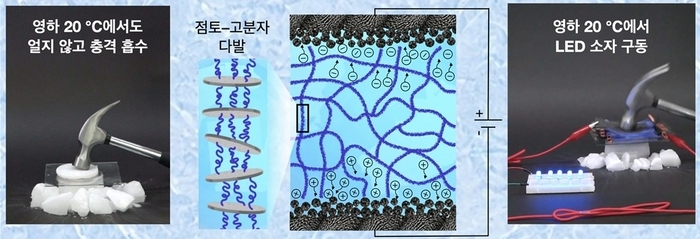
The team then soaked the gel in a concentrated lithium chloride solution to keep the water from freezing. Compared with a control gel, the new gel was about 21 times tougher, meaning it resists tearing far better, and its ionic conductivity was about 2.4 times higher. It kept its softness and its ability to carry ions at minus 20 degrees Celsius.
The shock-absorbing performance was also confirmed. When a steel hammer was dropped from a height of 15 centimeters at minus 20 degrees Celsius, bare glass and glass covered with a frozen conventional gel both broke. Glass covered with the team's gel remained intact even under repeated impacts. A supercapacitor made with the gel worked normally when bent 180 degrees at minus 20 degrees Celsius, and retained more than 91.6% of its initial performance after 5,000 charge-discharge cycles. A device made of five supercapacitors connected together lit an LED immediately after being struck by the hammer.
“The key was designing the hydrogel so that the region that withstands force and the region that transports ions each do their own job, improving both mechanical properties and ionic conductivity,” Professor Kim said. “The electrolyte handles both ion transport and impact cushioning, showing that a device can keep running after an impact even at minus 20 degrees Celsius,” said Dr. Jung.
The research was funded by the Ministry of Science and ICT through the National Research Foundation of Korea's Leading Research Center program, the Nano and Material Technology Development Program and its early-career researcher support program.
