

The global home appliance industry is losing momentum as demand stagnates in major developed markets, including the United States and Europe, and China slips into a downturn.
Chinese domestic demand, previously sustained by government stimulus measures, is contracting sharply. Appliance makers including Midea and Haier began reporting year-on-year revenue declines in the third quarter.
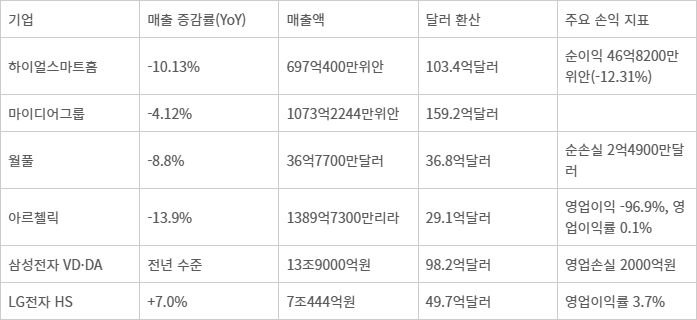
Haier Smart Home, the listed home appliance arm of Haier Group, reported third-quarter revenue of 69.704 billion yuan, down 10.13% from a year earlier. Net profit fell 12.31% to 4.682 billion yuan.
In its third-quarter report, Haier identified weakness in China's domestic market as a key reason for its disappointing performance. According to the report, retail sales in China's home appliance market totaled 179.1 billion yuan, down 10% year on year. Industry shipments in North America also fell 4% in the third quarter. Rising raw material and transportation costs, alongside China's shrinking domestic market, were cited as factors weighing on performance.
Midea's third-quarter revenue fell 4.12% year on year to 107.32244 billion yuan. Both Chinese appliance giants, which had continued to grow through the second quarter, saw revenue decline in the third.
Signs of weakness in China's domestic market had emerged as early as the second quarter. In its first-half earnings report, Midea said that although consumer trade-in subsidies remained in place, their stimulus effect was fading. Combined with a high comparison base from the previous year, this put considerable pressure on domestic appliance demand.
Revenue in Midea Group's appliance components business had already begun declining in the first half. The trend suggests that even China, long a growth engine for the global appliance industry, is now contracting.
Demand in the United States and Europe has been slowing for some time. U.S. appliance maker Whirlpool reported an 8.8% decline in third-quarter revenue and a quarterly net loss of $249 million. Around the release of its third-quarter results, the company also forecast a full-year loss.

Turkey's Arcelik, which has rapidly expanded its presence in Europe, faced similar difficulties. Third-quarter revenue fell 13.9% year on year, while operating profit plunged 96.9%. Its operating margin was just 0.1%.
South Korean manufacturers were not immune. Samsung Electronics' Visual Display and Digital Appliances businesses posted combined third-quarter revenue of KRW13.9 trillion, broadly unchanged from a year earlier, but their operating loss widened. Higher raw material and logistics costs weighed on results despite stronger sales driven by subscription offerings and business-to-business operations.
LG Electronics stood out. Its Home Appliance Solution division reported a 7.0% year-on-year increase in third-quarter revenue. With an operating margin of around 3.7%, it maintained stronger profitability than its U.S. and European peers.
As China's domestic downturn persists, industry observers expect Latin America, Southeast Asia and other markets in the Global South to become the next battleground for appliance manufacturers.
“Keeping cost pressures in check while targeting emerging markets where demand remains will be central to competitiveness in the appliance business,” an industry representative said.