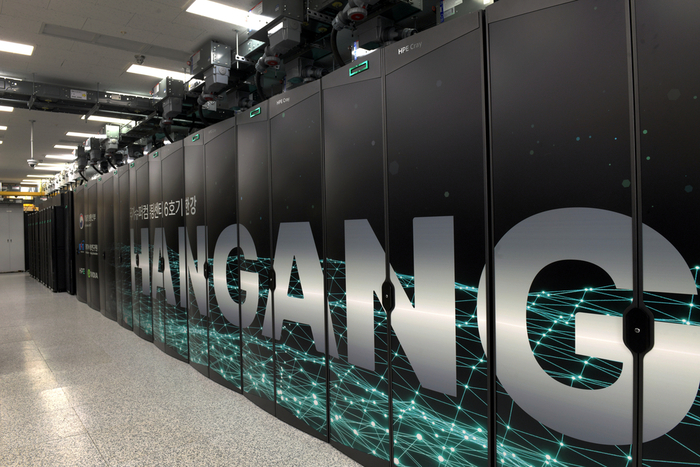


South Korea's sixth national supercomputer, a core infrastructure asset for the country's scientific and technological research, will officially begin providing services next month following a trial operation period. With computing power 24 times greater than its predecessor and specialized artificial intelligence (AI) capabilities, the system is expected to contribute to solving major national challenges.
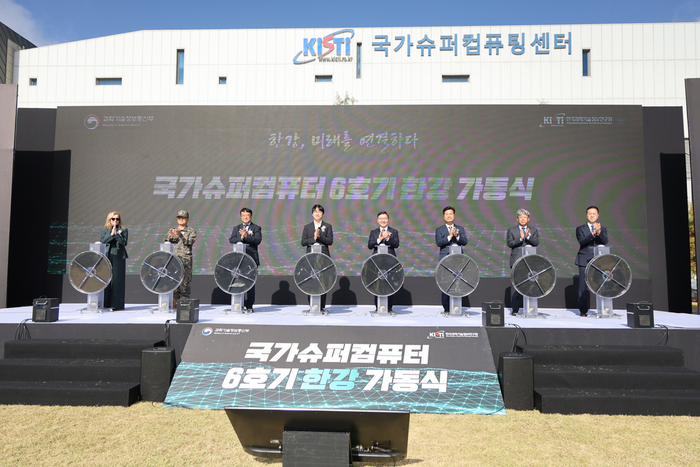
The Ministry of Science and ICT (MSIT) and the Korea Institute of Science and Technology Information (KISTI) held an inauguration ceremony for the sixth national supercomputer, Hangang, at KISTI headquarters in Yuseong-gu, Daejeon, on Nov. 2. It marks the first installation of a new national supercomputer in eight years, following the introduction of the fifth system, Nurion, in 2018.
A supercomputer is a system capable of analyzing and processing large volumes of data at much higher speeds than conventional computers. The government operates the national supercomputer program to reduce the burden on researchers in industry, academia and research institutions who would otherwise have to purchase expensive equipment individually or rely on private cloud servers.
The program began with the introduction of the first system, Cray 2S, in December 1988 and has continued through the fifth-generation system. These supercomputers have been used for crash simulations and engine design for domestically manufactured automobiles, weather forecasting, liquid rocket engine combustion simulations, next-generation battery development and research and development (R&D) on extreme climate conditions.
Nurion, the fifth national supercomputer, ranked 11th globally when it was introduced in 2018 and served as a key foundation for South Korea's scientific and technological research. Over the past eight years, Nurion supported a total of 1,730 research projects, resulting in the publication of 1,520 papers indexed in the Science Citation Index Expanded (SCIE).
Hangang, the sixth national supercomputer, will not only support the large-scale computational science and simulation research performed by its predecessor using central processing units (CPUs), but also introduce AI-based scientific research capabilities powered by the latest graphics processing units (GPUs). The new system is equipped with 8,496 advanced GPUs and 9,936 CPUs, including Nvidia's GH200 integrated CPU-GPU chips.
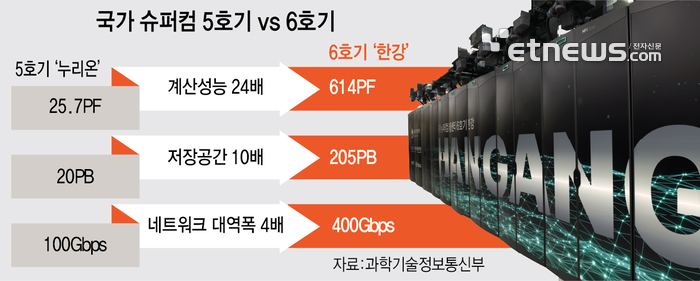
Compared with the fifth system, Hangang offers 24 times greater theoretical computing performance, 10 times more storage capacity and four times greater network performance. MSIT expects Hangang to rank among the world's top 10 supercomputers in the global performance rankings scheduled to be announced at the Supercomputing Conference (SC2026) in mid-November.
The sixth supercomputer project was originally scheduled to begin providing services in 2025, but it was delayed after four unsuccessful procurement bids caused by rising GPU prices amid the generative AI boom. Meanwhile, Nurion's international performance ranking fell to around 120th place.
Hangang will prioritize support for national strategic R&D initiatives, including K-Moonshot, an AI-based project aimed at solving major national challenges. Resource allocation ratios have been established to support a broad range of activities, from ambitious research at universities and government-funded research institutes to technology development by venture companies and startups. Following the recruitment of researchers in September, Hangang is currently undergoing trial operations and is scheduled to officially begin providing services on Dec. 14.
“We will ensure that Hangang, the sixth national supercomputer, serves as a foundation supporting ambitious research by domestic researchers,” said Lee Sik, president of KISTI. “Building on our experience operating supercomputers, we will do our utmost to ensure stable operations and provide support to users.”
“Hangang, the sixth national supercomputer, is a core infrastructure asset that will support the convergence of AI and science and technology, leading to new scientific discoveries,” said Kim Sung-soo, director general for research and development policy at MSIT. “We will actively support efforts to solve major national challenges through initiatives such as K-Moonshot, as well as innovative research across industry, academia and research institutions, to strengthen South Korea's competitiveness in science and technology.”