








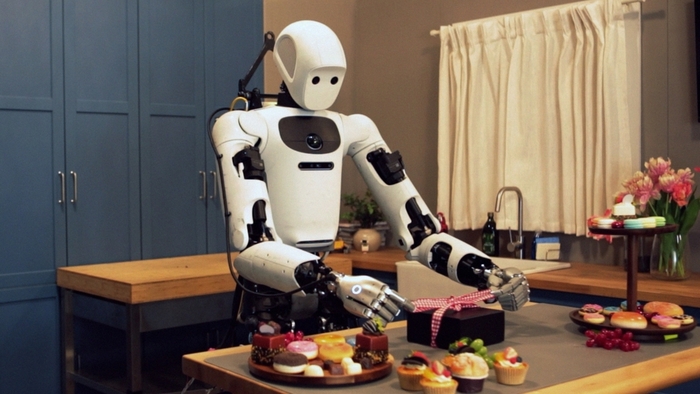
Google unveiled Gemini Robotics 2.5, a model specialized for physical artificial intelligence (AI) that enhances robots' precision manipulation capabilities and adaptability to real-world environments, on Nov. 10 (local time).
The next-generation vision-language-action (VLA) model enables robots to understand their surroundings, make decisions independently and take action, while also improving safety. Google demonstrated its potential for industrial applications by deploying humanoid robots on actual automotive production lines, achieving a 96% success rate in parts sorting and placement tasks.
Google evaluated the model's performance and ability to handle complex operations across more than 200 individual tasks. Compared with the previous model, success rates increased by 30% to 100%, depending on the type of task, while task completion speeds improved by 20% to 30%.
The company also confirmed performance improvements in actual industrial environments. Google partnered with U.S. robotics company Apptronik and Germany's Mercedes-Benz to deploy Apollo 2 humanoid robots on automotive production lines in Hungary and Germany.
Apollo 2 autonomously performed “kitting” tasks, retrieving automotive components from storage bins, sorting them according to the assembly sequence for each vehicle and placing them on trays. During the process, the robots independently adjusted the positions and spacing of components, achieving a 96% success rate in pilot testing.
Physical safety was also improved. Google enhanced real-time control capabilities to enable robots to recognize obstacles and people during operations and avoid potential hazards. In the company's internal evaluations, the rate of safely completing tasks around obstacles increased by 33%, while performance in environments with people improved by 43%.
Gemini Robotics 2.5 can be applied to various types of robots and is currently being rolled out to Google's robotics partners.
Google also expanded access to its next-generation frontier AI model, Gemini 4 Carbon, to developers, businesses, researchers and general users worldwide on the same day.
First unveiled on Oct. 28, Carbon is designed for complex, long-running tasks requiring advanced capabilities in software development, cybersecurity and scientific research. The model ranked first in three benchmark evaluations: CursorBench 4.0, Perplexity WANDR and Zapier AutomationBench.
Google also introduced a feature that allows multiple AI agents to divide responsibilities and collaborate through the “/swarm” function in Antigravity.
Carbon is available to paying developers and enterprise customers through Google AI Studio and Gemini for business. General users will gain access gradually through subscriptions to the Google AI Ultra plan.
