

Global automotive and industrial chipmakers are stepping up competition in robotics with a wave of new chips and development platforms. Drawing on control and communications technologies honed in vehicles and industrial automation, they are boosting performance, integrating more functions and strengthening software tools to target physical AI—systems that perceive and act in the real world.
Recent announcements from NXP Semiconductors, STMicroelectronics and Renesas Electronics highlight the push, with all three unveiling chips or development platforms that bring together key robotics functions.
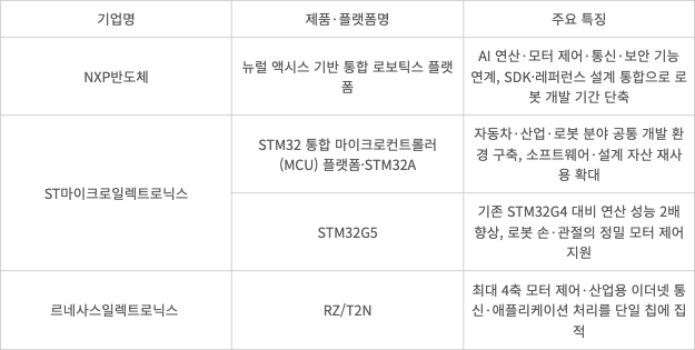
On Nov. 9, NXP announced a robotics platform combining AI computing, motor control, communications and security. Built on its Neural Axis architecture, the platform connects robotic perception and decision-making with real-time control.
NXP is focusing on easing development for robot manufacturers by providing an open software development kit (SDK) and prevalidated reference designs. The company said these tools could reduce system integration and validation work from several months to days or weeks.
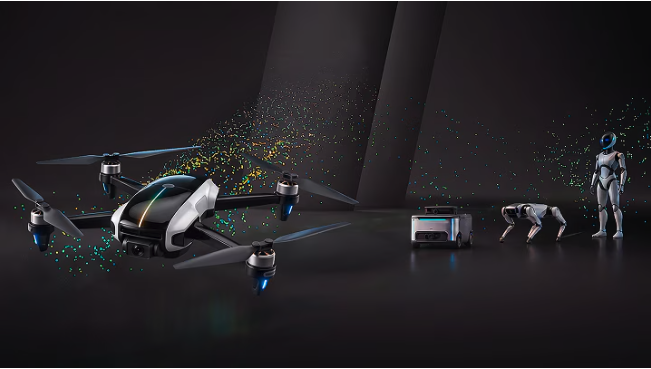
The platform will initially target drones. NXP plans to expand support to service robots and autonomous mobile robots (AMRs) in the second half of 2027.
On Nov. 4, STMicroelectronics unveiled a unified STM32 microcontroller (MCU) platform for industrial equipment, vehicles and robots. By connecting development environments previously separated by industry, the platform allows developers to reuse existing software and designs across applications.
The same day, ST introduced the STM32G5, a new MCU targeting precision control of robotic hands and joints. It offers twice the computing performance of the STM32G4, along with motor-position encoder support and high-resolution timers to enable precise, simultaneous control of multiple motors.
Renesas followed on November 5 with the RZ/T2N microprocessor (MPU), which integrates control functions for industrial robots and automation equipment into a single chip.
The RZ/T2N supports up to four-axis motor control, industrial Ethernet communications and Linux-based application processing on one chip. Renesas said consolidating functions previously handled by multiple chips could reduce circuit board space and component costs while simplifying system development.
Robots require more than AI-based perception and decision-making. They must also coordinate motor control, sensor data processing and real-time communications to move precisely.
That combination is prompting automotive and industrial chipmakers to adapt and enhance their established control and communications technologies for robotics. By integrating more functions into individual chips and unifying software development environments, they aim to reduce the complexity of building robotic systems and strengthen their competitive position.
“As autonomous robots move beyond controlled environments and into the spaces where people live and work, trust becomes a prerequisite for adoption,” said Jerome Legros, vice president of robotics at NXP. He emphasized the importance of integrating security, functional safety and real-time control technologies.