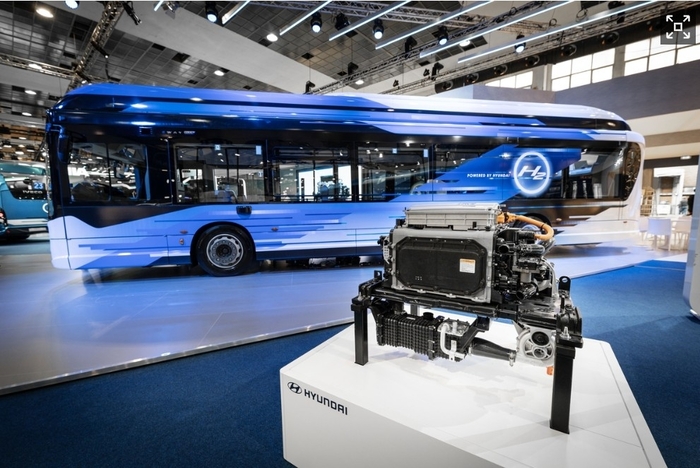


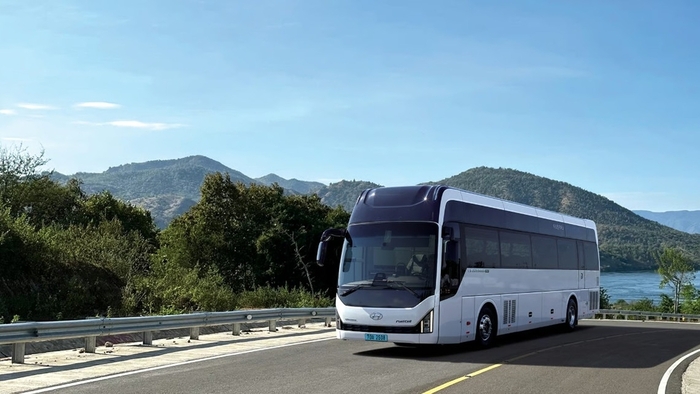
Hyundai Motor Company will launch South Korea's largest hydrogen fuel cell express bus next year, measuring nearly 13 meters in length, the legal maximum for a single vehicle. As cost-competitive Chinese battery electric buses rapidly gain ground in the domestic city bus market, Hyundai aims to solidify its leadership in the large, long-distance hydrogen commercial vehicle segment, where technological barriers to entry remain high.
According to industry sources on Nov. 3, Hyundai Motor recently completed vehicle emissions certification for its “Elec City Hydrogen Fuel Cell Express Bus” (model designation CYEX401-A27FCEV6T-C) from the Transportation Pollution Research Center of the National Institute of Environmental Research (NIER). This marks the first time Hyundai has added an extra-large, 13-meter-class low-floor hydrogen bus to its mass-production lineup.
Hyundai is expected to manufacture and distribute the new model at its Jeonju plant next year after completing the remaining procedures, including vehicle specification registration with the Ministry of Land, Infrastructure and Transport (MOLIT) and safety testing.
The new bus is equipped with a powerful powertrain designed for express routes that require extended operation on highways and urban expressways. It combines a high-performance traction motor delivering a maximum output of 475 horsepower (350 kW) with Hyundai's independently developed polymer electrolyte membrane fuel cell (PEMFC) hydrogen system and a 48.3-kWh high-voltage lithium-ion battery pack (630 V, 76.6 Ah).
The vehicle has a curb weight of 13.6 metric tons and a gross vehicle weight of 16.2 metric tons. Its driving range on a single hydrogen refueling has been optimized to reliably handle round-trip express bus routes in the Seoul metropolitan area.
The significance of the new model lies in Hyundai's use of technology to resolve a dilemma created by conflicting government policy requirements. Under amendments to the Act on Promotion of the Transportation Convenience of Mobility Disadvantaged Persons, the government has made it mandatory for bus operators to introduce low-floor buses equipped with wheelchair-accessible spaces when replacing route buses.
However, standing passengers are legally prohibited on express buses that primarily operate on urban expressways for safety reasons. Operators therefore need to secure approximately 40 seats or more to maintain economically viable operations.
In conventional 11-meter low-floor bus bodies, accommodating wheelchair spaces reduces seating capacity sharply to between 20 and 30 seats, prompting opposition from transport operators. Hyundai addressed both accessibility for mobility-disadvantaged passengers and operational profitability by significantly extending the vehicle body, providing wheelchair-accessible facilities while securing a total capacity of 41 seats, including the driver's seat.
The new model also aligns with the government's policy to transition public transportation toward environmentally friendly vehicles. The Ministry of Environment plans to increase the cumulative number of hydrogen buses in operation from approximately 3,000 currently to more than 20,000 by 2030. Once the 13-meter-class hydrogen express bus enters the market, it is expected to capture substantial demand for replacing aging diesel buses on major express routes in the Seoul metropolitan area.
Industry analysts also say hydrogen technology overcomes some of the limitations of battery electric buses. Operating a large bus with heating and air conditioning over high-speed round-trip routes exceeding 100 kilometers requires heavy batteries weighing several metric tons, creating obstacles such as increased curb weight and charging wait times of one to two hours. Hydrogen buses, by contrast, can be fully refueled within 15 to 20 minutes, enabling continuous long-distance operations.
In South Korea's domestic market for 11-meter urban battery electric buses, Chinese manufacturers such as BYD have increased their market share to around 40%, leveraging inexpensive lithium iron phosphate (LFP) batteries.
By contrast, controlling large 13-meter vehicle bodies and ensuring the durability of hydrogen fuel cells under demanding operating conditions remain areas where Chinese manufacturers would find it difficult to catch up in a short period.