




OpenAI has demonstrated the potential of ChatGPT in policy research by conducting a study that predicts and verifies the household consumption effects of the 'Livelihood Recovery Consumption Voucher' policy using generative AI.
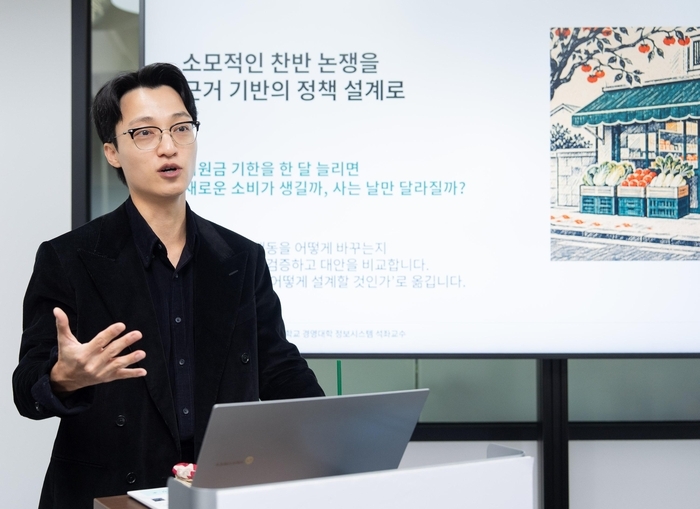
Kwon Hyuk-goo, a chair professor in the Information Systems Department at Nanyang Technological University (NTU) in Singapore, stated at the 'Open Insights: AI Applications in Policy Research' media session held at OpenAI's office in Gangnam-gu, Seoul on the 11th, “We will train GPT on individual consumer lifestyles and spending patterns to verify the effectiveness of government subsidy policies.”
This research is one of 14 global projects selected for OpenAI's 'Industrial Policy Research Support Program.' Kwon's research team analyzed changes in household consumption following the first disbursement of the government's Livelihood Recovery Consumption Vouchers last year through GPT-based simulations.
The core focus is predicting consumption responses based on individual consumer characteristics and policy conditions. The researchers provide the GPT model with information such as individual income, spending habits, subsidy amounts, and usage deadlines via an application programming interface (API). The AI then comprehensively analyzes this data to predict changes in spending and whether additional consumption occurs.
A key feature is that researchers do not manually set consumer behavior rules. Traditional economic and policy research often uses 'rule-based agent models (ABM),' where researchers define individual consumer behavior rules. In contrast, this study allows the AI model to generate consumption responses by analyzing consumer characteristics and policy conditions holistically.
Kwon explained, “GPT interprets consumer situations and policy conditions based on human behavior knowledge and patterns acquired during training. While this approach does not guarantee more accurate predictions, it reduces the burden of manually setting behavior rules for researchers.”
The reliability of AI predictions is verified by comparing them with actual consumption records. The study contrasts AI predictions with the spending history of the same consumers before and after receiving vouchers and utilizes the Bank of Korea's analysis of voucher policy effects.
Kwon emphasized, “When delegating behavior to GPT, three aspects must be verified: information, representation, and reasoning. We must validate what information is provided to the AI model about consumers, how the same information is processed and represented, and to what extent predictions from AI can be trusted.”
A second-phase study is underway, altering voucher usage deadlines and eligible vendors. The research analyzes whether extending deadlines stimulates additional consumption or merely shifts purchase timing, aiming to identify policy improvements.
The team plans to validate AI predictive power against actual consumption records by next month and compare/analyze the effects of policy alternatives based on voucher usage conditions by the end of March next year.
Eum Seong-won, Head of Communications at OpenAI Korea, stated, “OpenAI's mission is to bring the benefits of AI to all humanity, and we hope to expand AI's benefits in policy research. To this end, we are supporting global university research teams, including NTU's research group, through dedicated programs.”
