



The Ministry of Science and ICT has begun formulating the 5th Basic Plan for Biotech Development, which will serve as the foundation for bio-policy over the next decade. Aiming for innovation through AI integration, it challenges to create new industries and secure a global core position.
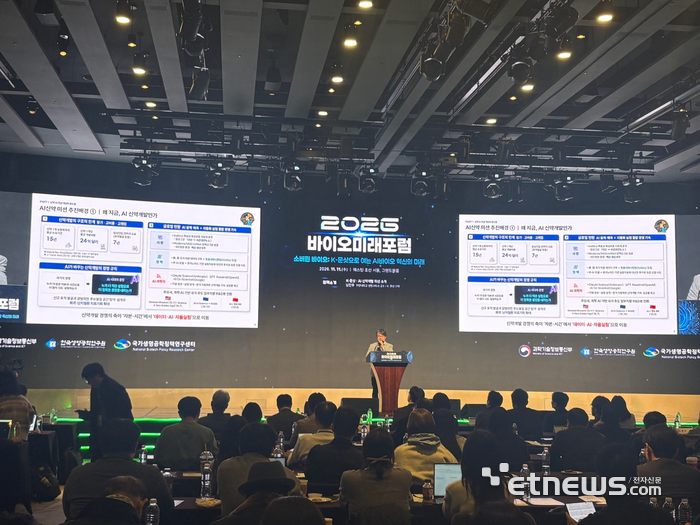
The Ministry of Science and ICT held the '2026 Bio Future Forum' with the Korea Research Institute of Bioscience and Biotechnology's National Policy Center for Biotechnology at the Westin Chosun Seoul in Jung-gu, Seoul on the 11th. Under the theme 'Sovereign Bio: The Future of AI Bio Innovation through K-Moonshot,' strategies were discussed to leap forward as a global AI bio powerhouse amid global technological hegemony competition.
On this day, Lee Joo-heon, head of the Advanced Bio Division at the Ministry of Science and ICT, announced the 7 major SEED advanced bio sector promotion strategies and the direction of the next Basic Plan for Biotech Development. The government included the advanced bio sector in the '7 major SEED projects' to secure national future growth engines and is preparing a pan-governmental implementation strategy linked to R&D, infrastructure, and commercialization.
Specifically, the Ministry of Science and ICT, Ministry of Health and Welfare, Ministry of Trade, Industry and Energy, and Ministry of SMEs and Startups will establish support measures throughout the entire cycle—including existing projects, follow-up tasks, investment/finance, licensing/verification—for five items: AI new drug development, brain future industries, gene/cell therapy, bio manufacturing, and organoids within the year. Although South Korea possesses the world's largest bio production capacity and ranks second in AI bio paper contributions, it reflected field opinions that the ability to link research outcomes to commercialization is insufficient.
The 'K-Moonshot Project,' which solves national challenges through AI, selected AI new drug development and brain-computer interface (BCI) fields to begin securing future technologies. The new drug development field aims to improve AI new drug development speed 10-fold by 2035, and the BCI field targets commercialization of BCI technology by 2035, with R&D projects starting next year.
In the fourth quarter of next year, the 5th Basic Plan for Biotech Development—the top statutory R&D plan—will be finalized. The basic plan presents a mid- to long-term national vision and policy direction every 10 years. The Ministry of Science and ICT has set future leadership, strategic assets, and mission orientation as the three core areas. Based on this, key tasks such as future medical core technologies, innovative bio manufacturing technologies, and strategic supply chain stability strategies will be identified. Currently, basic diagnostics and trend analyses are underway.
At the forum, 13 commendations from the Deputy Prime Minister of the Ministry of Science and ICT were awarded to individuals who achieved outstanding results in bio R&D, industry promotion, and policy establishment by 2026. Recipients included Kim Geon-su, CEO of Qurincell; Park Yong-geun, CEO of Tomocube; and Professor Kim Hyung-sik of Pusan National University.
Oh Dae-hyun, Director of Future Strategic Technology Policy at the Ministry of Science and ICT, stated, “As AI's role expands in the R&D process and the convergence of existing technologies with AI is accelerated, the public and private sectors must unite their capabilities so that the advanced bio sector can become South Korea's future growth engine.” He added, “The government will expand strategic investments in future bio technologies through national projects like the 7 major SEEDs and K-Moonshot to realize a great leap forward in the bio sector.”
