


South Korea's two largest cryptocurrency exchanges, Upbit and Bithumb, both posted operating losses in the third quarter as trading volumes fell for a second consecutive quarter. The downturn has sharply eroded profitability at exchanges that depend heavily on trading fees, fueling calls to open the retail-dominated market to corporate and institutional investors.
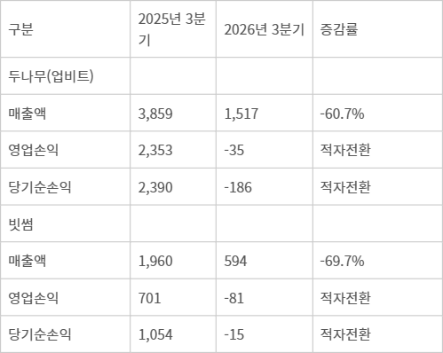
According to filings available on the Financial Supervisory Service's electronic disclosure system on Nov. 16, Upbit operator Dunamu reported consolidated revenue of KRW151.7 billion and an operating loss of KRW3.5 billion for the third quarter. Revenue fell 60.7% from KRW385.9 billion a year earlier, while the company swung from an operating profit of KRW235.3 billion to a loss. It also posted a net loss of KRW18.6 billion, reversing a year-earlier profit.
The deterioration was also evident against the previous quarter, when Dunamu recorded revenue of KRW173.5 billion and an operating profit of KRW23.5 billion. Third-quarter revenue declined 12.6% sequentially, pushing the company into an operating loss. Operating expenses, meanwhile, rose 3.1% year over year to KRW155.2 billion from KRW150.6 billion. Persistent costs, combined with declining trading fee revenue, weighed on profitability.
Bithumb also swung to an operating loss in the third quarter. Revenue dropped 69.7% to KRW59.4 billion from KRW196 billion a year earlier. The exchange reported an operating loss of KRW8.1 billion, compared with an operating profit of KRW70.1 billion in the same quarter last year.
In the second quarter, Bithumb generated revenue of KRW86.3 billion and an operating profit of KRW12.1 billion, but had already slipped to a net loss of KRW21.8 billion. Revenue fell a further 31.2% in the third quarter, pushing its operating result into the red as well. Its net loss narrowed to KRW1.5 billion but remained a loss for a second consecutive quarter.
Falling cryptocurrency trading volumes were a key factor behind both companies' weaker results. According to CoinGecko data, combined trading volume at South Korea's five major exchanges offering won-denominated trading totaled $133.222 billion in the third quarter. That was down 9.1% from $146.503 billion in the previous quarter and 38.9% from $218.195 billion in the first quarter.
The exchanges' heavy reliance on trading fees has amplified the impact. Trading platform fees accounted for 96.04% of Dunamu's revenue in the first nine months of the year. At Bithumb, trading fees made up 99.99% of revenue over the same period. That leaves both companies' revenue and profitability directly exposed to declines in trading activity.
Industry calls are growing to open the market to corporate and institutional investors. Supporters argue that bringing in corporate capital would deepen liquidity and create a new foundation for growth, reducing the market's dependence on individual investors. Although the Financial Services Commission announced a roadmap for allowing corporate cryptocurrency trading in February last year, trading by listed companies and corporations classified as professional investors has yet to get fully underway, one year and nine months later.
Speaking at D-CON 2026 on Nov. 10, Dunamu Vice Chairman Kim Hyoung-nyon said South Korea's digital asset industry was technically ready to expand, but regulation was preventing new business initiatives.
“Securities firms, financial institutions and Dunamu have long since completed all the necessary technical preparations,” Kim said. “Corporate and institutional investment in crypto assets needs to be opened up as soon as possible.”
“Corporate trading can move forward through a decision by financial regulators alone,” an industry official said. “Allowing corporate and institutional investors into the market would not only bring in fresh capital but also help narrow the 'kimchi premium'—the price gap between cryptocurrencies traded in South Korea and overseas—through arbitrage, while making the market more stable.”