





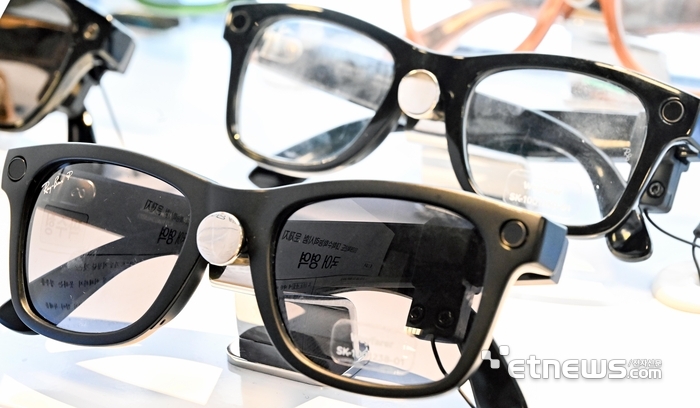
As cheating with AI glasses and miniature electronic devices spreads, 'anti-AI cheating' technologies are gaining attention. Countermeasures range from detecting wireless signals, blocking communications, identifying AI glasses, to restricting AI services from solving exam questions. Countries are diversifying their approaches.
However, each technology has issues such as detection accuracy, communication interference, and costs. In South Korea, there is also a lack of legal grounds to permit signal blocking, highlighting the need for institutional improvements alongside technological responses.
◇From Radio Detection to Jamming: Technological and Legal Challenges in Blocking AI Cheating
The Korea Communications Agency (KCA) is developing a mobile radio detector to counter AI-assisted exam cheating. The technology identifies the presence of devices via Bluetooth signals and analyzes Wi-Fi communication patterns to detect suspicious use of AI services. It can be applied to cheating methods involving smart glasses, ultra-small cameras, smartphones, and wireless earbuds.
Radio detection senses signals generated when exam questions captured by ultra-small cameras are transmitted to smartphones or when AI-analyzed answers are sent to wireless earbuds. Equipment supporting specific frequency bands can also detect mobile communication signals like LTE.
However, distinguishing cheating devices is challenging due to simultaneous signals from multiple wireless devices inside and outside exam venues. Additionally, if cameras and AI processing are integrated into a single device operating without external wireless communication or via wired connections, radio signal detection alone may fail.
Considering the complex wireless environments in exam venues, KCA has expanded simulation and verification processes beyond initial plans. The project is currently in the software and prototype development phase. A KCA official stated, “The core technology lies in targeting specific Bluetooth or Wi-Fi signals,” adding, “Due to many on-site variables, we've increased simulation and verification efforts.”
Jamming technology, which blocks communication by emitting interference signals in specific frequency bands, is another potential solution. It can prevent smartphones and wireless earbuds from transmitting data but is ineffective against on-device AI systems that operate without external wireless communication. There are also risks of disrupting nearby communications, as interference signals may spread beyond the target area.
A radio expert noted, “Current technology can block wireless communication within specific exam venues, but nationwide implementation—like for the CSAT—would require significant costs.” The expert added, “While localized signal blocking is possible, there's a risk of affecting external communications.”
Legal revisions are also necessary to deploy jamming in domestic exam settings. Article 29 of the current Radio Waves Act generally prohibits interference or blocking of others' radio use. Exceptions are made for public safety purposes such as presidential security, military activities, and counterterrorism, but national exams like the CSAT or licensing tests are not included.

◇Global exam centers on alert over 'AI cheating'…China blocks signals, US researches smart glasses detection
China has already deployed signal-blocking equipment during the college entrance exam (Gaokao) to prevent cheating via wireless communication. Some regions have even temporarily halted signal transmission from nearby mobile base stations or reduced their output. According to the Chinese Ministry of Industry and Information Technology, 30,705 personnel, 7,306 mobile monitoring vehicles, and 15,624 sets of signal-detection equipment were mobilized for this year's Gaokao.
Major Chinese AI companies are also participating in anti-cheating efforts. Tencent's “Yuanbao” and Moonshot AI's “Kimi” restricted image-input functions during exam periods, while Alibaba's AI service “Quark” suspended photo-based problem-solving services. ByteDance's “Doubao” temporarily rejected uploads of exam images.
In the U.S., research is underway to identify smart glasses. A Duke University research team led by Professor Maria Gorlatova published a paper this year highlighting that augmented reality (AR) glasses produce unique reflection patterns and light leakage at specific angles, proposing a method to distinguish them from regular glasses.
Institutional measures to restrict AI devices in exam venues are also strengthening. The College Board, which administers the SAT, explicitly banned all glasses capable of accessing the internet or AI services—including smart glasses—from exam rooms. The UK's Joint Council for Qualifications (JCQ) similarly prohibits wearable devices like smart glasses. Built-in AI features such as Microsoft Copilot and Apple Intelligence are also subject to control.
Taiwan's University Entrance Examination Center plans to include in its 2027 academic year regulations that wearing or carrying smart glasses constitutes a major violation.
