





Security Budgets to Increase Up to 2.8 Times Next Year
Restricting External System Access Permissions
Automated Detection and Blocking of Anomalies
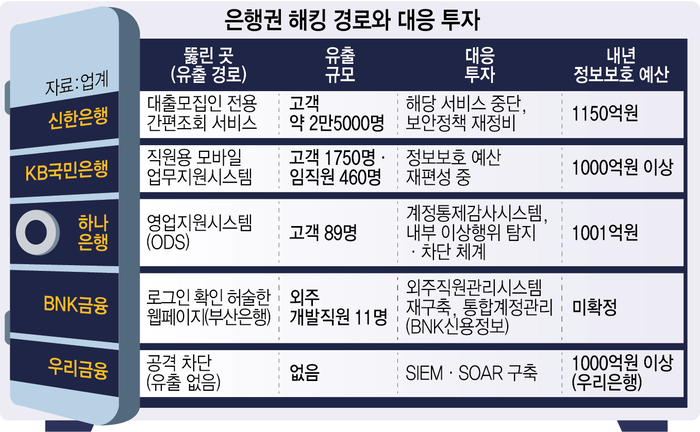
A domestic bank, which suffered a series of cyberattacks leading to customer data breaches, is overhauling its account and access management systems. This follows hackers exploiting weak “access permissions” in business systems used by loan agents, employees, and outsourced personnel, rather than targeting core banking networks handling deposits and loans. Banks are accelerating revisions to their permission control systems while increasing their 2025 information security budgets by up to 2.8 times.
According to financial industry sources on the 16th, Hana Bank has begun introducing an account control and audit system, which restricts permissions for each system access account and audits usage history. Last month, Hana Bank's operational support system (ODS) was attacked, resulting in the leakage of 89 customers' resident registration numbers, addresses, and workplace information.
BNK Financial Group's BNK Information is building an integrated account management system, while Busan Bank is reportedly restructuring its outsourced staff management system. Busan Bank confirmed that after a previous external attack, personal information of 11 outsourced developers was exposed through a web page with lax login status verification. iM Financial Group's IT subsidiary, iM Data System, is implementing a network and security equipment access control system.
Investments are also increasing to detect intrusions faster. Woori Financial is deploying a Security Information and Event Management (SIEM) system to collect and analyze access logs across systems for anomalies, as well as a Security Orchestration, Automation, and Response (SOAR) system to automatically block threats. Hana Bank is also introducing equipment to detect and automatically block internal suspicious activities.
Recent cyberattacks in the financial sector all exploited gaps in “permissions.” At Shinhan Bank, approximately 25,000 customers' annual incomes and loan limits were leaked through a simplified inquiry service for loan agents. At KB Kookmin Bank, information of 1,750 customers and 460 employees was exposed via a mobile business support system for staff.
Weak authentication and access controls in application programming interfaces (APIs)—which connect systems for data exchange—were identified as vulnerabilities. If servers do not re-verify requesters' permissions, attackers can alter identifiers like customer numbers to access others' data.
Criticism arises that account management alone is insufficient. KB Kookmin Bank has invested in work account authorization management and database (DB) access control since 2019, yet failed to prevent leaks through employee work systems exposed externally. The challenge remains to verify whether external requests are actually authorized, beyond internal server-centric controls.
The Financial Services Commission will conduct a full inspection of authentication and access control systems, APIs, and external interfaces across 580 financial institutions by the end of the year. It will also hold CEOs, Chief Information Security Officers (CISOs), and Chief Information Officers (CIOs) accountable. Security internal control guidelines will be released in the first quarter of next year. From September 30 to October 3, 40 security breaches were reported by 37 financial institutions, involving approximately 473,000 leaked records.
Banks are increasing security budgets. Shinhan Bank allocated 115 billion won for information security next year—about 2.8 times this year's 40.6 billion won. Hana Bank plans 100.1 billion won, while Woori Bank and KB Kookmin Bank will allocate over 100 billion won each.
A banking industry official stated, “How effectively the increased budget is applied to authorization controls and external interface verification will determine whether recurrences can be prevented.”
