




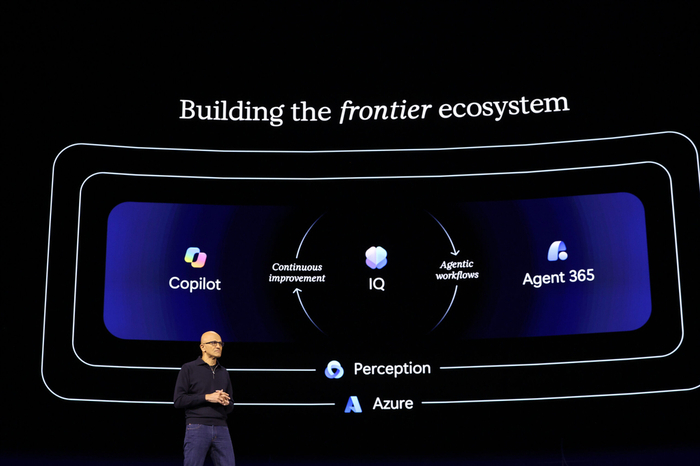
Microsoft has unveiled its “frontier ecosystem” strategy aimed at improving business efficiency and delivering tangible business results through the use of artificial intelligence (AI) agents.
Microsoft CEO Satya Nadella emphasized at the annual technology conference Microsoft Ignite 2026, held at Chase Center in San Francisco on Nov. 17 (local time), that “technological advances must be translated into tangible outcomes for people, organizations and society as a whole.” He added, “To achieve this, organizations must put human goals at the center, take control of how they use and learn from AI, and build trust.”
Microsoft's frontier ecosystem focuses on expanding human capabilities through AI, enabling organizations to take control of AI adoption and building trust. To this end, the company plans to evolve its AI work tool, Copilot, beyond a simple productivity tool into a new operating system (OS) that supports business operations across enterprises.
Volkswagen Group has established an environment that allows more than 330,000 employees to use Copilot. Copilot Chat has more than 300,000 monthly active users (MAUs) and is being used across core business functions, including engineering, production, procurement and sales. More than 26,000 AI agents were also active within the group over the past month. Estee Lauder has likewise expanded Copilot adoption to more than 14,000 office employees worldwide.
Microsoft also highlighted business innovation achievements resulting from combining companies' proprietary data and expertise with AI. Global financial services company Northern Trust developed an AI onboarding agent based on Excel and SharePoint, reducing the time required to prepare client data by 83%, from two and a half weeks to three days. In performance testing, the agent achieved a first-pass evaluation rate of 96.5%.
In South Korea, KT used AIO-Net, an AI agent platform jointly developed with Microsoft, to reduce network anomaly detection time from more than 10 minutes to two to three minutes. The company also cut the time required for incident investigations and report preparation by roughly half, to an average of five minutes. AI checks equipment status and recommends response measures, while humans make the final decisions and take action.
Saint-Gobain used Microsoft Discovery to transform 62,000 patents and 44,000 research abstracts into an AI-ready knowledge base in just a few hours. The task was expected to take a year using conventional methods. In approximately six weeks, the research team developed hypotheses related to cement additives and is validating them in the laboratory.
Publicis Groupe has deployed Microsoft 365 Copilot to all 114,000 employees. The company is also jointly developing AI agent workflows with Microsoft based on Microsoft IQ, which leverages enterprise knowledge and data.
Microsoft also emphasized the importance of establishing security and management systems to expand enterprise AI adoption. The company explained that businesses must maintain control over their own data and AI training while establishing frameworks for security and cost management. Global financial services company BNY is considering adopting Project Perception based on its experience using Microsoft's security solutions.
3M is building an AI agent-based order management system that automates credit checks, delinquency assessments and system updates. The system includes human approval procedures and a dedicated dashboard for real-time monitoring.
According to an IDC study commissioned by Microsoft, 66% of companies achieved significant results from AI adoption, but only 48% managed to expand its use across multiple business units or translate it into sustained results. The findings suggest that the focus of AI competition is shifting from technology adoption to expanding its use across organizations and generating tangible business outcomes.
Nadella also unveiled Copilot Workspaces, a platform that enables AI agents and employees to collaborate in a shared workspace. The platform provides a collaborative environment in which AI agents work alongside team members, share work-related information and carry out tasks together in real time.
Microsoft also introduced Microsoft-Decision-1.1, an AI model specialized in enterprise decision-making. The company said the model processes decision-related tasks, such as classification and prioritization, more than 10 times faster than general-purpose large language models (LLMs). It also unveiled HorizonDB, which integrates real-time transaction and analytics data, and Microsoft IQ, which systematically organizes internal enterprise knowledge.
