





The South Korean government plans to invest KRW53.5 billion over five years starting next year in the Next-X Humanoid Challenge. Through a series of competitive rounds, the program will identify leading homegrown humanoid platforms and support their development, real-world testing and commercialization.
The Ministry of Science and ICT held a preliminary briefing on Nov. 24 at Space Share's Seoul Station 3 Center, together with the National Research Council of Science & Technology, the National Research Foundation of Korea and the Korea Robotics Society. Organizers outlined the program's rationale, key elements and schedule, and gathered feedback from industry, academia and research institutions.
The program will have two phases: a competition in 2027-2028, followed by further development support in 2029-2031. The government plans to allocate KRW23.5 billion to the first phase and KRW30 billion to the second.
Under the draft plan, applications will open for one month from mid-February next year. Around 10 teams will be selected in April following reviews of written submissions and videos, along with on-site inspections. Each team will receive between KRW1 billion and KRW3 billion in research and development funding over two years, with funding levels varying by team. Participants will also have access to government-secured graphics processing units (GPUs), data generated through physical AI initiatives and simulation environments.
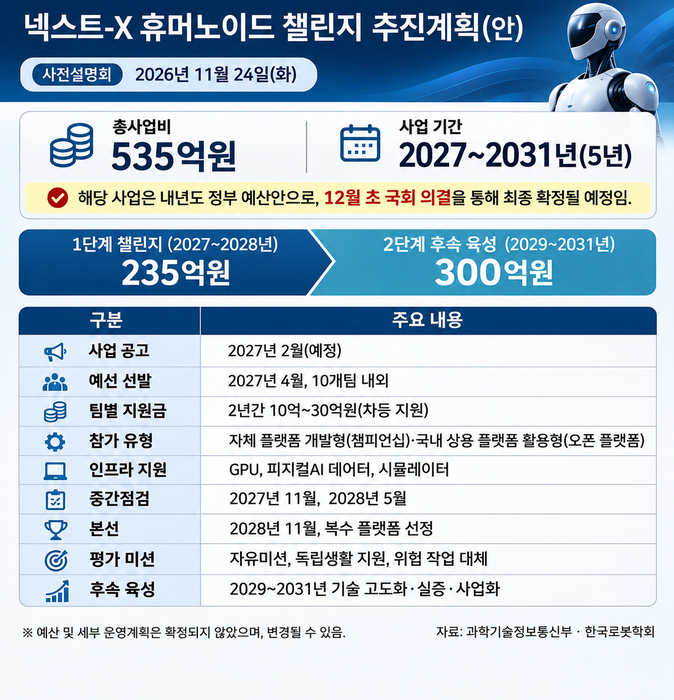
Participants will compete in two tracks: “Championship,” for teams developing their own humanoid platforms, and “Open Platform,” for teams developing AI and software using commercially available South Korean platforms. Both bipedal and wheeled robots will be eligible, with no restrictions on robot configuration. Evaluations will place particular emphasis on teams' control over their platforms' core technologies.
Key criteria will include mechanical and physical design, software architecture, system integration, basic motion generation and in-house control capabilities. Teams will not be permitted to enter by purchasing and modifying complete foreign-made humanoids, including those from China.
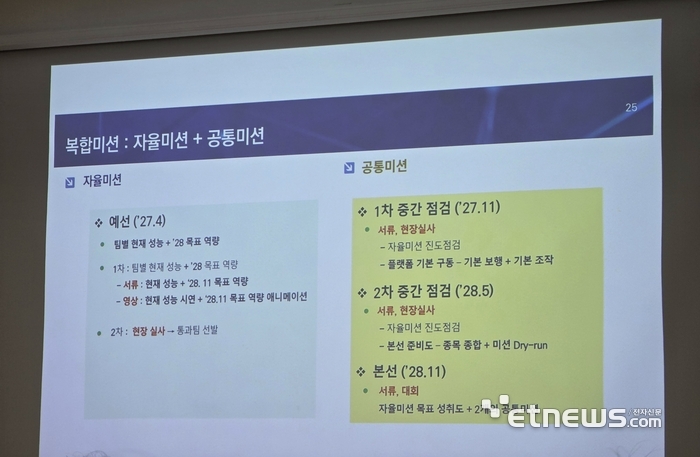
In the preliminary round, teams will be assessed on their current technical capabilities and development goals through missions of their own choosing. Two interim reviews are scheduled for November 2027 and May 2028, followed by the final round in November 2028. The final will assess both achievement of team-defined mission goals and performance in shared missions, such as helping people live independently and taking over hazardous tasks. Multiple humanoid platforms will be selected through this process.
At the briefing, participants from industry, academia and research institutions proposed stricter requirements for domestically produced actuators, incentives to develop proprietary physical AI models, and separate evaluation frameworks for teams pursuing ambitious technical breakthroughs and those developing commercially viable platforms.
The program's budget is expected to be finalized following a National Assembly vote early next month. The ministry will refine eligibility requirements, evaluation criteria and funding arrangements before issuing the final program announcement in February next year.
“The goal of this challenge is not simply to select winners, but to build a support system that helps these platforms grow into national champions,” said Choi Jong-seok, president of the Korea Robotics Society.
