








Generative artificial intelligence (AI) adoption in South Korea is rising at one of the fastest rates in the world, according to a new report.
Microsoft's think tank, the AI Economy Institute, released its “AI Diffusion Report: Q1 2026 Trends and Insights” on May 12.
According to the report, the share of working-age people globally using generative AI rose from 16.3% to 17.8% in the first quarter of 2026, an increase of 1.5 percentage points. In economies with higher levels of AI adoption, usage intensity has also increased. Currently, 26 economies have recorded AI usage rates exceeding 30% among their working-age populations.
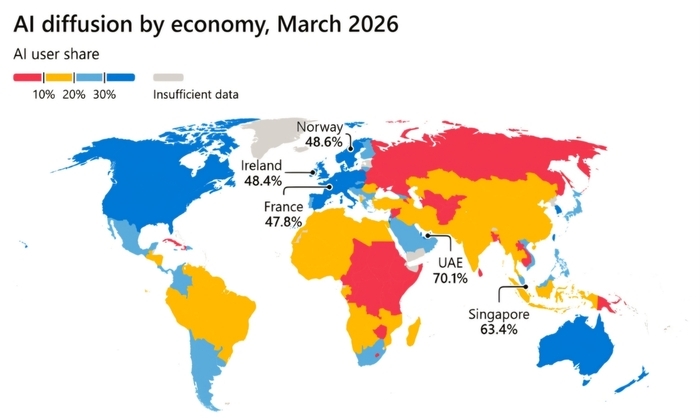
The number of countries surpassing the 30% threshold grew from 18 to 26 over the quarter. By country, the United Arab Emirates led the world with 70.1%, becoming the first nation to exceed the 70% mark. It was followed by Singapore (63.4%), Norway (48.6%), Ireland (48.4%), and France (47.8%).
South Korea recorded a sharp increase of 6.4 percentage points to 37.1%, marking the fastest growth globally. The country also climbed from 18th to 16th place in the global rankings.
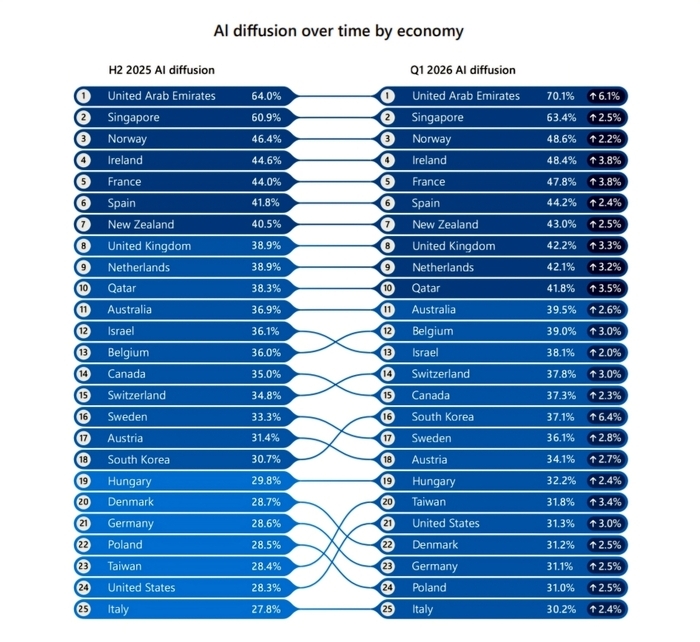
Notably, 12 of the 15 fastest-growing markets are located in Asia. The report attributes this growth to several factors, including long-term investment in digital infrastructure, national-level AI strategies, high consumer acceptance, improvements in model performance for Asian languages, and the region's ability to rapidly integrate new technologies into everyday life and economic activity.
On the technical side, stronger support for local languages and advances in multimodal interaction capabilities were identified as key drivers of AI diffusion. In particular, improvements in non-English performance--reflected in multilingual benchmarks such as MMMLU, which evaluates knowledge tasks across 14 languages--have enabled AI tools to handle multilingual workloads more effectively. As a result, accessibility has improved across everyday use cases such as messaging, search, learning, and content creation.
User demand and enterprise adoption have also accelerated. According to research by McKinsey & Company, AI adoption in Southeast Asia is progressing faster than the global average, with a growing number of organizations moving beyond pilot programs into full-scale deployment.
The influence of AI in software development has also become more pronounced. Coding-focused systems developed by major companies such as Anthropic and OpenAI have demonstrated strong performance in handling complex engineering tasks. In particular, GPT-5.3-Codex achieved top results on the SWE-Bench Pro evaluation. Meanwhile, GitHub Copilot is evolving beyond a code suggestion tool into an AI-native development platform.
