








Serving as the 'brain' for task and computing management
Implementing an ecosystem to break free from foreign technology dependency
Partnering with KATECH and others for development and verification
Targeting project completion by 2029
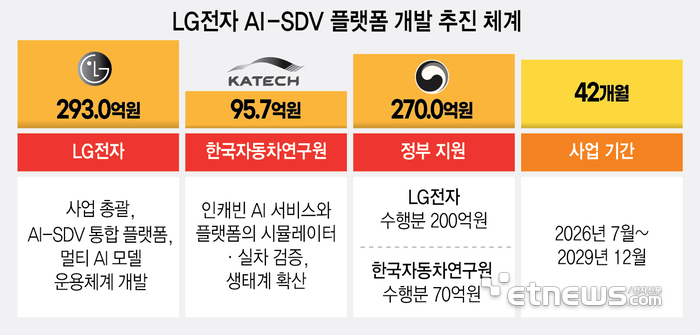
LG Electronics is developing an open automotive artificial intelligence (AI) platform that can be used regardless of big tech operating systems (OS), vehicle manufacturers, or vehicle models. The goal is to create an “automotive brain” that executes various AIs and applications and manages task sequencing and computing regardless of the hardware and software (HW/SW) applied to the vehicle. LG Electronics, which has stood out in the vehicle component solutions business, has stepped up to strengthen its technological competitiveness in the era of AI-defined vehicles (AIDV) beyond software-defined vehicles (SDV).
According to related industries on August 26, LG Electronics recently embarked on the development of a common AI-SDV platform in collaboration with related institutions and companies. LG Electronics, in cooperation with the Korea Automotive Technology Institute (KATECH), will verify the developed platform in actual vehicles and build development tools and test environments for external companies to use. The goal is to complete the project by 2029.
LG Electronics' AI-SDV platform is expected to be combined with SDV middleware developed by Hyundai Mobis. It is a structure in which LG Electronics provides an environment for developing and operating AI and application services for Hyundai Mobis vehicles and control programs. The two companies will verify the platforms developed mutually in actual vehicles.
An SDV is a vehicle that implements automotive functions through software rather than mechanical devices. Even after delivery, functions can be added or performance can be improved through over-the-air (OTA) updates. While traditional automobiles installed dozens of electronic control units (ECUs) by function, SDVs integrate them into a central computer. Updates are possible just like a smartphone.
Reducing the development burden resulting from using different semiconductors for each vehicle is also a research goal. The company will establish a development environment that can tie together different central processing unit (CPU), graphics processing unit (GPU), and neural processing unit (NPU) configurations according to finished vehicle makers and vehicle models into a single platform.

When the service is commercialized, small and medium-sized software companies will also be able to produce services based on a common platform without developing separate programs tailored to automotive OSs provided by big tech companies such as Google or Nvidia. This implements an open automotive software ecosystem with low dependency on foreign technologies.
Core AIs to be operated on the platform will also be developed. This includes multimodal AI that identifies driver and passenger status through sensors inside the vehicle. An AI memory that stores user usage history and an automotive AI agent will also be created together.
Securing places for application after technology development remains a challenge. However, as Hyundai Mobis participated, the possibility of verification and initial application through Hyundai Motor Group vehicles is being raised.
An official from LG Electronics explained, “The goal is to develop an AI-SDV integrated platform and cloud verification environment based on global standards and open source,” adding, “It is a research and development effort for core software platform technology and ecosystem creation required in the AIDV era.”
An industry official predicted, “The core challenge is to ensure that choosing a specific foreign vendor's semiconductor and OS does not tie vehicle data, AI, and applications to the same vendor's ecosystem,” adding, “Automakers will be able to broaden their choice of suppliers and combine technologies from multiple companies, while suppliers will also be able to supply a variety of software.”
