







Electricity Amount Shared Silmuntaneously by 1.5 Million Households
Stable Supply Decides AI Competitiveness
Concentration in Capital Area... Benefits for Regional Relocation Needed
A survey has shown that the demand for electricity to be used by domestic data centers will exceed at least 1.5 gigawatts (GW) in three years. This is equivalent to the amount of electricity used simultaneously by about 1.5 million households (based on a four-person family). Observers note that a stable supply of power has emerged as a key variable that will determine the success or failure of the expansion of domestic artificial intelligence (AI) data centers and the industry as a whole.
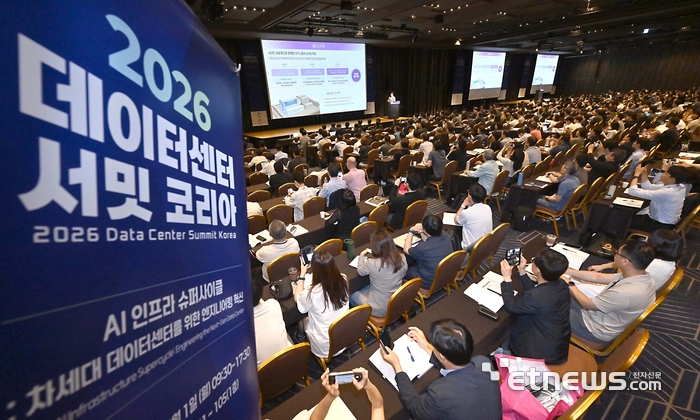
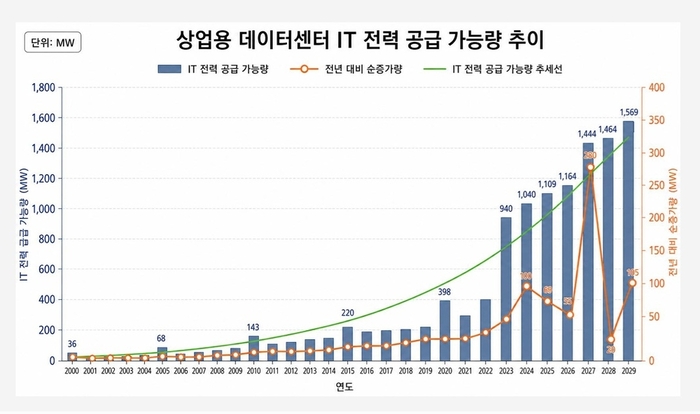
According to the 'Korean Data Center Market 2026-2029' report released on June 1 at the 'Data Center Summit Korea 2026' event co-hosted by the Electronic Times and the Korea Data Center Council (KDCC) at Coex in Samseong-dong, Seoul, the amount of electricity used by data centers, namely the 'IT power supply capacity,' was surveyed to soar up to 1,569㎿ (1.5GW) by 2029.
The IT power supply capacity refers to the power that goes only into driving servers and storage, that is, IT equipment, excluding air conditioning, cooling, etc., among data center infrastructure (which accounts for about 30% of total data center operating power).
Although the power capacity of domestic commercial data centers was only at the level of 398 megawatts (㎿) as of 2020, it surpassed 1,000㎿ last year, and it is expanding nearly fourfold in just nine years. This is a scale where the entire electricity produced by one nuclear power plant must be fully injected solely to run data centers. When converted to general homes based on a four-person household, it is a level of electricity volume that can be used simultaneously by about 1.5 million households.
This is interpreted as a result of a sharp surge in demand for large hyperscale data centers and generative AI-exclusive data centers that consume dozens of times more power than general data centers, along with the all-out expansion of cloud services.
The problem lies in the fact that demand for data centers is concentrating in the capital area, where it is difficult to receive power supply.
Currently, 73.4% of domestic private data centers are concentrated in the metropolitan area, including Seoul, Gyeonggi, and Incheon, causing power grid overload and substation saturation. The floor space utilization rate of commercial data centers in the capital area, where actual demand is flocking, averaged 92.43%, which has already reached a saturated state. Nevertheless, 65.0% of data centers currently 'promoting construction' still insist on locations in the capital area, appearing to aggravate the uncertainty of power supply. In particular, because it usually takes more than 10 years to build additional ultra-high-voltage transmission networks and substations, analysis indicates it is insufficient to handle the immediately surging demand for AI data centers.
Signs of a turnaround were also captured, such as 76.7% of 30 data centers in the 'planning stage' choosing non-capital areas due to the government's regional dispersion policy. However, critics point out that there is still a long way to go until actual infrastructure supply.
Accordingly, apart from the mid-to-long-term task of building large-scale power infrastructure, voices are also being raised that a 'short-term prescription' to solve the immediate power bottleneck is urgent.
Lee Seung-hee, director at Megazone, pointed out in a keynote presentation on this day, “To induce the relocation of data centers to non-capital areas, unconventional exclusive communication network rate discount benefits must be provided to private companies moving down to regions, and powerful human resource support measures that can solve the problem of regional workforce supply and demand must be carried out in parallel.”
Meanwhile, the event on this day is the only data center event in Korea held every year since 2021, and more than 1,000 visitors attended to share domestic and foreign data center industry trends and technology trends.
Kang Joong-hyup, chairman of the Korea Data Center Council, emphasized, “The power supply and demand problem, the concentration in the capital area, carbon neutrality requirements, balanced regional development, improving awareness of data centers, and the lack of AI data center experts are homework assignments that the government and companies must solve together.” Kang added, “Now is a time when practical execution that works on-site is needed rather than grand discussions.”
