








South Korea's battery industry is moving into full-scale production and conversion of lithium iron phosphate (LFP) batteries and energy storage systems (ESS). The shift is aimed at offsetting slowing growth in the electric vehicle (EV) market by capitalizing on rising demand for ESS and expanding LFP battery production.
According to industry sources on June 8, the country's three major battery manufacturers--LG Energy Solution, Samsung SDI, and SK On--are set to accelerate production expansion and manufacturing line conversions for ESS-focused LFP batteries in the second half of this year. The move reflects a broader transition from EV-centered production toward a more diversified portfolio that includes ESS and LFP batteries.
ESS has emerged as a new growth engine for the battery sector, driven by the expansion of renewable energy, increasing demand for grid stabilization, and rising electricity consumption from artificial intelligence (AI) data centers. As cost competitiveness and supply stability are key considerations in the ESS market, adoption of LFP batteries is also growing rapidly.
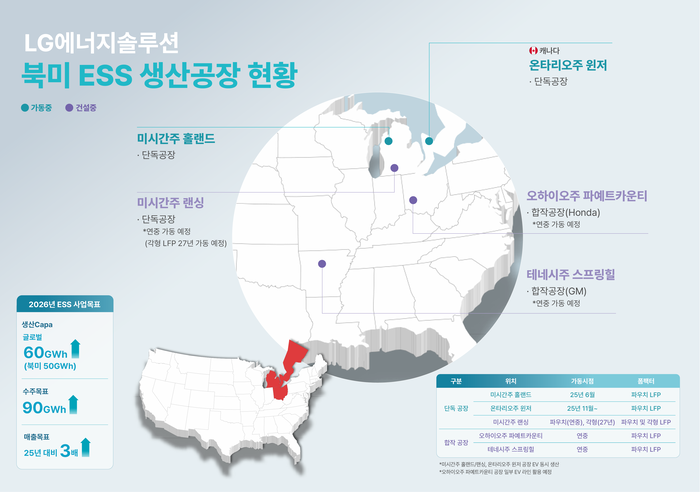
LG Energy Solution is expanding its production capacity and order intake in the North American energy storage system (ESS) market. The company plans to increase its global ESS battery production capacity to more than 60 GWh by the end of this year, with over 50 GWh allocated to North America. Its North American manufacturing base will expand to five sites, including the Holland plant in Michigan, the NextStar Energy facility in Canada, the Lansing plant in Michigan, the Ultium Cells Tennessee plant, and the Honda joint venture plant in Ohio.
Samsung SDI is preparing to begin mass production of ESS-focused lithium iron phosphate (LFP) batteries in the United States in the second half of the year. In response to U.S. Inflation Reduction Act requirements regarding non-FEOC (Foreign Entity of Concern) sourcing, the company is also building a China-free supply chain for LFP cathode materials. Samsung SDI has signed a long-term supply agreement with L&F for LFP cathode materials, which will be used in its U.S.-based ESS battery production.
SK On is converting 3 GWh of capacity at its 7 GWh Seosan plant in South Chungcheong Province into a dedicated ESS LFP battery production line. The company plans to complete pilot production by the end of this year and supply ESS LFP pouch batteries to its facility in South Jeolla Province. In North America, part of its Georgia plant will also be converted into an ESS LFP-dedicated line.
The ESS transition by the three major battery makers is also generating new demand across the supply chain. M Plus, a secondary battery equipment specialist, plans to expand orders in response to increased investment in ESS conversion and prismatic battery production. GFI, a fire safety component company, intends to scale up supply of fire suppression kits, fire blankets, and thermal runaway prevention pads amid rising ESS demand from AI data centers.
As the gap between order intake and capacity expansion decisions narrows, supplier capabilities in delivery speed and cost competitiveness are becoming increasingly important. Beyond equipment supply, process stabilization and on-site responsiveness are emerging as key competitive factors.
An industry official noted, “The shift toward ESS and LFP presents significant opportunities for equipment and component makers, but companies must balance cost efficiency with process stability within a short timeframe. From the second half of the year, engineering capability and delivery responsiveness will become even more critical for suppliers.”
