








SK Telecom (SKT) and KT have secured the first pilot project under the government's Hyper AI Network Strategy. The core objective is to develop and validate Physical AI services by leveraging technologies such as 5G Standalone (SA), while laying the groundwork for next-generation network environments. With the nation's leading telecommunications operators and equipment vendors participating, the initiative is also expected to accelerate the development of infrastructure needed to position Korea as one of the world's top three AI powers.
According to government sources on the 16th, the Ministry of Science and ICT and the National Information Society Agency (NIA) selected two consortiums led by SKT and KT as preferred bidders for the High-Performance AI Network Testbed Project. The final contracts are expected to be signed as early as this month, after which the project will officially commence.
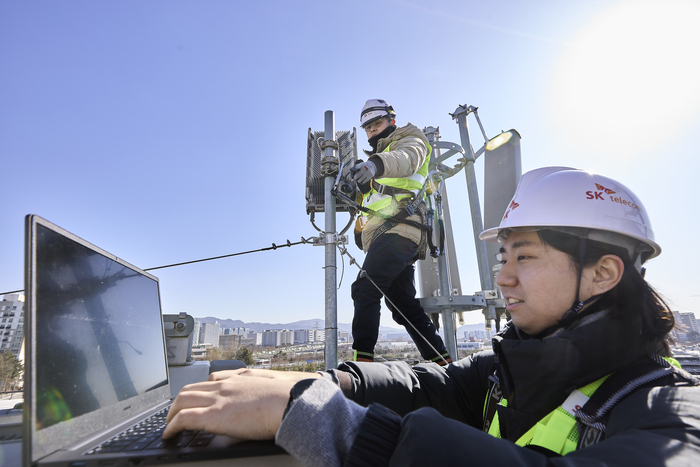
The project aims to upgrade existing commercial networks into advanced test networks by leveraging technologies such as 5G Standalone (SA) and AI-RAN (Artificial Intelligence Radio Access Network), while developing and validating a range of AI-converged services. A total of KRW 16 billion (approximately USD 12 million) will be invested through 2027.
The government plans to configure the newly established test networks to support advanced capabilities, including network slicing based on 5G SA architecture. The initiative will also create a testbed for applying AI-RAN technologies to commercial networks and explore broader next-generation network applications, such as utilizing reallocated 4G spectrum for 5G services. In particular, the project seeks to develop and validate Physical AI services within the test network environment, with the ultimate goal of accelerating their commercialization.
As a follow-up measure to the Hyper AI Network Strategy unveiled by the government late last year, the project has attracted significant industry attention as the first non-R&D initiative under the strategy. Beyond its symbolic significance, the program is viewed as particularly appealing because it focuses on technologies that can be developed, tested, and potentially commercialized within one to two years, independent of longer-term core technology development efforts.

All three major Korean mobile carriers--SK Telecom, KT, and LG Uplus--formed consortiums and engaged in intense competition to secure the project. Key evaluation criteria included consortium composition, financial contributions, and the feasibility of business plans.
SK Telecom highlighted its position as the only Korean member of the board of the AI-RAN Alliance and formed a consortium with HFR, Intellivix, Seoul Robotics, and Clavie. The consortium brought together a broad ecosystem spanning network equipment, robotics, and AI solutions providers.
On the demand side, SK Incheon Petrochem and KG Mobility joined the consortium as pilot partners. SK Incheon Petrochem plans to demonstrate and operate an industrial safety system within refinery facilities using quadruped robots in the advanced network environment, while KG Mobility will test an autonomous vehicle transport service for finished automobiles.
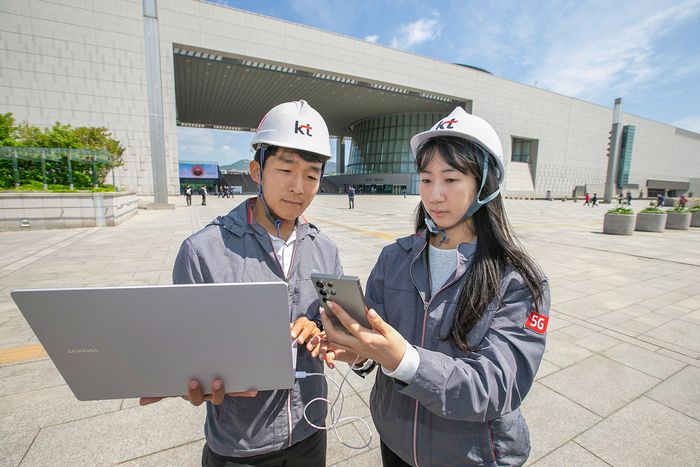
KT also emphasized its experience operating KOREN, Korea's dedicated ultra-high-speed research network, and 5G Standalone (SA) infrastructure as key strengths. The company's strategy extends beyond building next-generation network infrastructure to driving its commercial deployment. To this end, KT formed a consortium with Solid, Ariel Networks, Woorinet, the Telecommunications Technology Association (TTA), and Yonsei University.
For service demonstrations, KT plans to collaborate with HD Hyundai Samho to develop and deploy AI-based autonomous systems tailored for shipyard operations. The project will focus on validating advanced AI applications in industrial environments enabled by next-generation network technologies.
Most of the network equipment used in the project, including base station equipment, will be supplied by domestic companies such as Samsung Electronics. The initiative is designed not only to strengthen technological self-reliance through the localization of next-generation network technologies, but also to support the global expansion of Korean networking solutions.
“This project is fundamentally about upgrading commercial networks to validate services such as Physical AI,” said Na Sung-wook, head of the Intelligent Network Division at the National Information Society Agency (NIA). “The goal is not merely to conduct demonstrations. Companies must actively invest based on proven technologies and service models so that these innovations can advance to the commercialization stage.”
