








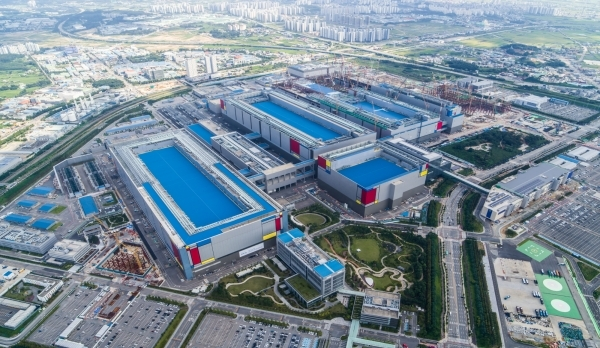
A government-led meeting aimed at attracting a new Samsung Electronics semiconductor plant to the Honam region is expected to take place later this month.
According to industry sources on June 9, the government is expected to meet with major corporations as early as the end of June to discuss investment plans outside the Seoul metropolitan area. A proposal to establish a Samsung Electronics semiconductor facility in Honam is reportedly one of the key agenda items.
Currently, South Korea's major semiconductor manufacturing complexes are concentrated in the greater Seoul area, including Pyeongtaek, Hwaseong, and Yongin. This marks the first time that a government-led discussion on building a semiconductor fabrication plant in Honam has been seriously pursued. Potential sites include Gwangju, where plans are underway to relocate a military airport, and the Advanced District 3 development zone in Jangseong County, South Jeolla Province. If realized, the project could bring investments worth several trillion won to the region.
Separate from the Yongin Semiconductor Cluster, officials are reportedly considering establishing a new facility focused on semiconductor packaging operations in Honam. The move is viewed as part of a broader strategy to promote balanced regional development while strengthening South Korea's advanced packaging capabilities in the AI era.
Government officials and ruling party lawmakers have discussed various regional investment initiatives related to the Yongin Semiconductor Cluster since late last year. During the June 3 local elections, numerous candidates also pledged to attract Samsung semiconductor facilities to their regions. Among them, Min Hyung-bae, the newly elected inaugural mayor of the proposed integrated Gwangju-Jeonnam metropolitan city and a former lawmaker, promised to secure more than 10 trillion won in semiconductor-related investments within his first year in office.
Late last year, the Ministry of Trade, Industry and Energy identified the creation of a “Southern Semiconductor Innovation Belt” as one of its seven key strategic initiatives. The plan calls for specialized semiconductor clusters in Gumi (materials and components), Busan (power semiconductors), and Gwangju (advanced packaging) to reduce the concentration of industry in the Seoul metropolitan region.
President Lee Jae-myung also signaled support for large-scale regional investment projects during a press conference marking the first anniversary of his inauguration on June 8. He stated that the government would soon unveil a major investment initiative designed to transform the nation's growth strategy and emphasized the need to achieve greater regional balance by providing additional support to the Honam area.
However, many in the semiconductor industry have questioned the feasibility of establishing a major semiconductor manufacturing facility in Honam. The sector relies heavily on highly skilled engineers and advanced-degree researchers, and companies already face difficulties recruiting talent even in regions adjacent to the capital area, such as Chungcheong Province.
Industry experts also note that semiconductor competitiveness depends on a tightly integrated ecosystem that includes fabless designers, foundries, materials and equipment suppliers, and packaging companies. While competing countries are concentrating resources within major semiconductor clusters, dispersing production facilities for political reasons could weaken South Korea's overall competitiveness, critics argue.
Another challenge is the supplier network. Even if a major company such as Samsung were to establish operations in Honam, it would be difficult for hundreds of partner firms to relocate alongside it given the additional logistics costs and workforce constraints.
Samsung Electronics, meanwhile, dismissed reports of a proposed Honam semiconductor plant, stating simply that it was unaware of any such plan.
