








A global alliance in which 6th-generation (6G) mobile communication organizations from major countries, including South Korea, the United States, China, and Japan, join hands will launch at the end of this year. This is the first time that representative organizations from each country have established a single cooperation system to jointly respond to next-generation communication technologies. As a turning point of shifting beyond competition and into cooperation has been prepared, the influence of South Korea, which led the launch, is also expected to grow.
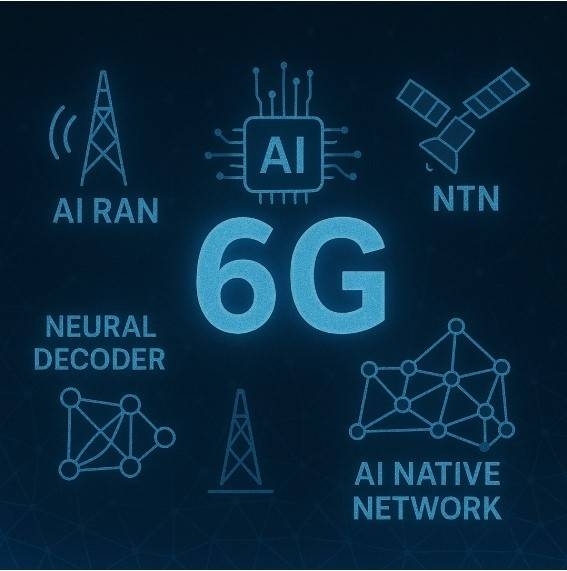
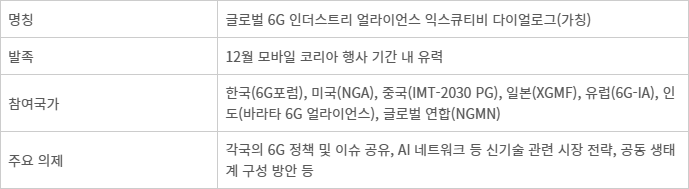
According to industry sources on June 10, the Global System for Mobile Communications Association (GSMA) plans to newly establish the 'Global 6G Industry Alliance Executive Dialogue (tentative name)' composed of 6G associations and organizations from major countries around the world near the end of the year.
The alliance is being launched to share technology development, spectrum policies, standardization directions, and future business models that are being diversely discussed in various regions around the world ahead of the commercialization of 6G in 2030, and to create a joint ecosystem.
6G organizations from six countries--South Korea (6G Forum), the United States (Next G Alliance, NGA), China (IMT-2030 Promotion Group, IMT-2030 PG), Japan (XG Mobile Forum, XGMF), Europe (6G Smart Networks and Services Industry Association, 6G-IA), and India (Bharat 6G Alliance)--will join as initial members. The overall operation will be managed by GSMA, and the Next Generation Mobile Networks Alliance (NGMN), a global mobile communication technology alliance, will also participate.
The establishment of a single cooperation system by the 6G organizations representing each country is due to concerns that an intense competition for early dominance ahead of 6G commercialization could cause an 'early fragmentation' of technology, standardization, policy, and even the market. A consensus was formed to build a cooperative system for next-generation network directions and market formation amid the great transformation of artificial intelligence (AI), which has never been experienced before. The fact that the United States and China, which are fighting for hegemony not only in telecommunications but also in most industrial sectors, are participating in the launch of this alliance is in the same context.
Kim Tae-kyung, GSMA North-East Asia head, said, “Beyond the technical discussions that have been carried out through various organizations so far, discussions to generate practical outcomes, such as 6G commercialization and business strategies, are scheduled to take place.” Kim added, “We plan to hold meetings at the MWC event site in the first half of the year, and tour around each country in the second half of the year.”
The launch of the global 6G alliance is expected to be a turning point where the competition for next-generation communication hegemony, represented by 6G and AI, expands into 'cooperation.' In this process, South Korea is expected to seize an opportunity to lead the process of creating a new order.
In fact, the 6G Forum of South Korea has led the overall operations, including inviting participating countries and running the event, since the alliance's first task force (TF) meeting held at MWC26 last March. The official launch and kickoff meeting of the alliance in the second half of the year is also highly likely to be held in connection with 'Mobile Korea,' which will be hosted by the 6G Forum in South Korea this coming December.
Jang Kyung-hee, 6G Forum executive committee chair (Inha University professor), said, “As it is the first alliance where global 6G organizations gather, our goal is not only to host the kickoff meeting but also to secure leadership in operations.” Jang postseasoned, “The fact that we took a pragmatic diplomatic and technical strategy in the telecommunications field along with world-class technological prowess will definitely be a competitive edge.”
