






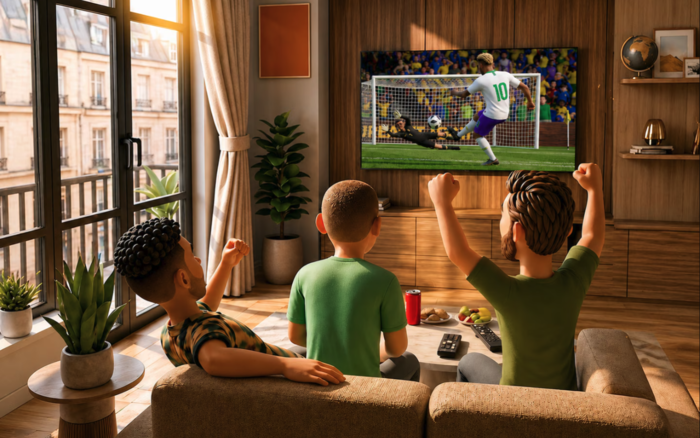
As the 2026 FIFA World Cup kicks off in North America on June 11 (local time), major global electronics companies are unveiling advanced artificial intelligence technologies designed to differentiate their products. Analysts say the event could mark a turning point, shifting the industry away from decades of hardware-driven competition focused on screen size, resolution, and processor performance.
Samsung Electronics and LG Electronics are both introducing a wide range of AI-powered features tailored for the tournament. Unlike traditional display technologies centered on picture quality alone, these systems are designed to understand content context and automatically optimize the viewing experience.
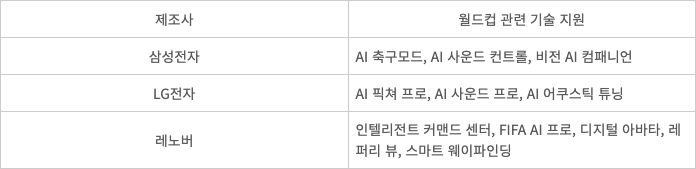
Samsung's latest lineup includes an “AI Football Mode Pro,” which analyzes live matches in real time, enhancing pitch details and team jersey colors while accurately tracking fast-moving ball trajectories without distortion. Its “AI Sound Control Pro” separates crowd noise from commentary, allowing viewers to adjust audio elements individually.
For example, fans seeking atmosphere can amplify stadium cheers, while those focusing on tactical analysis can isolate commentary. The concept emphasizes a TV that responds dynamically to the game without requiring manual control.
LG Electronics is also pushing forward with its own innovations. Its dual AI engine-based “AI Picture Pro” processes each frame independently across wide-angle stadium shots, close-ups, and slow-motion replays, maintaining color accuracy and contrast even during rapid scene changes.
The “AI Sound Pro” system continuously adjusts multiple audio layers, while “AI Acoustic Tuning” uses a microphone built into the Magic Remote to deliver both immersive stadium ambience and clear commentary.
As a result, viewers no longer need to constantly adjust volume levels as crowd noise fluctuates during matches.
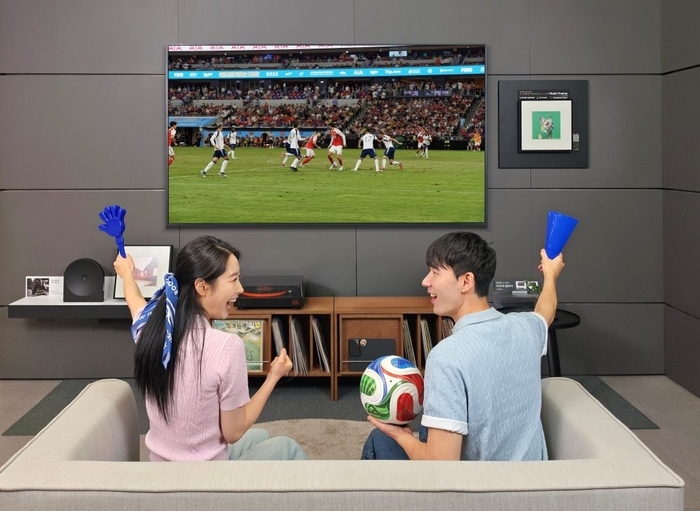
Samsung Electronics and LG Electronics have introduced AI features ahead of the 2026 World Cup that allow devices to automatically analyze viewing conditions and optimize settings without any user input. The systems are designed to minimize viewer intervention, with AI taking over adjustments in real time. This reflects a shift from defining product value at the point of release to a structure where devices evolve through software updates and continuous AI learning.
While past competition in the TV market focused on thinner panels, higher resolution, and wider color gamut, software capabilities are now emerging as a central battleground. As hardware specifications have reached a plateau and perceived differences for consumers have narrowed, companies are increasingly turning to AI as a new competitive frontier.
Lenovo, the world's leading PC maker, is serving as an official technology sponsor of the World Cup, supplying AI infrastructure across event operations and broadcasting systems. The partnership is seen as a new model in which hardware manufacturers demonstrate software and service capabilities through major global sporting events.
Lenovo is providing five core AI solutions. Its Intelligent Command Center acts as a centralized hub for pre-, during-, and post-match operations, using digital twin technology of stadiums to support predictive decision-making. FIFA AI Pro analyzes more than 2,000 match metrics to deliver real-time tactical insights to coaches, players, and analysts as an AI-powered knowledge assistant.
A Digital Avatar system creates 3D models reflecting player biometric data to assist referee decisions such as offside calls, while Referee View offers AI-stabilized broadcast footage from the official's perspective. Smart Wayfinding provides real-time route optimization powered by AI, from airports to stadium seating. Some of these technologies are also being integrated into broadcast feeds for viewer experience.
An industry official noted that the changes ahead of the 2026 World Cup go beyond simple feature additions, adding that TV and PC manufacturers are now positioning software and AI services as their core competitive strengths.