









The domestic artificial intelligence (AI) semiconductors have been confirmed to meet the performance requirements of demanding companies and possess superior performance compared to global graphics processing units (GPUs). Under the full-cycle support of the government--spanning research and development (R&D), demonstration, and performance verification--combined with corporate technological capabilities, the self-reliance of next-generation semiconductor technology is accelerating.
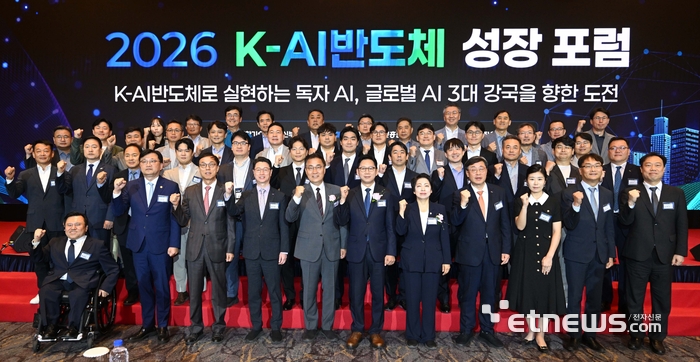
On June 4, the Ministry of Science and ICT (MSIT) held the 'K-AI Semiconductor Growth Forum' at the Lotte Hotel in Sogong-dong, Seoul, to share the performance evaluation results and development strategies of domestic AI semiconductors.
The event was organized to share the performance of R&D and demonstration in the domestic AI semiconductor field and corporate growth strategies. In particular, the results of the domestic AI semiconductor performance evaluation (K-Perf) were disclosed for the first time.
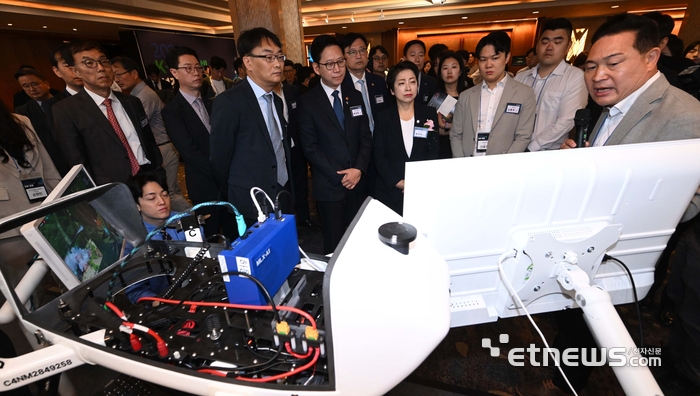
The evaluation conducted testing and verification on two products, 'Renegade' by FuriosaAI and 'REBEL 100' by Rebellions, targeting widely used AI services such as △AI chatbot service △document search service △report generation service and △large-scale document analysis service.
As a result, both products satisfied the service level objectives (SLO) required by demanding companies after repeated tests under various conditions, including input/output size (ISL·OSL) and concurrent user scale. In the AI chatbot service field verification, both products recorded a question-and-answer response time in the 1-second range, which is approximately 7 to 8.5 times faster than human reading speed. Both AI document search and large-scale document composition recorded a latency in the 1-second range, boasting a speed up to 13 times faster than humans.
Based on this performance, major domestic AI semiconductors signed export contracts worth over 30 million USD in overseas markets. They also won the Best of Innovation Awards at CES, the world's largest consumer electronics exhibition.
At the event, domestic AI semiconductor companies shared success cases linked to real commercial services, such as △SK Telecom's A. call summary service (Rebellions) △Samsung SDS's subscription-based AI semiconductor service (FuriosaAI) △public civil complaint analysis service based on civil complaint-specialized LLM (HyperXcell) △Hyundai Motor Group's next-generation robotics platform (DEEPX) and △MetaM's AI call center counseling service (Mobilint).
It is expected that by proving superior performance compared to global products, reliance on GPUs can be resolved in the future, while achieving technological self-reliance.
Kim Su-kyung, team leader at Gyeongnam Technopark, said, “Currently, we are providing site-edge wild forest fire monitoring cameras and drones utilizing domestic NPUs.” Kim added, “With the introduction of domestic NPUs, the processing speed improved twofold compared to foreign GPUs, accuracy was at an equivalent level, and power efficiency improved 13 times, confirming that it is at a level fully utilization-ready in actual disaster fields.”
MSIT and the Institute for Information & Communications Technology Planning & Evaluation (IITP) have been continuing full-cycle support from R&D to commercialization, demonstration, and funding regarding domestic AI semiconductors since 2020. This year, they are investing 143 billion KRW to support neural network processing unit (NPU) performance advancement, next-generation processing-in-memory (PIM) development, and full-stack HW·SW technology development for K-Cloud realization.
Bae, deputy prime minister and minister of science and ICT, said, “I thought NPU technology was considered a low-power, low-cost model, but now it has entered the stage of making products with global-level competitiveness and being applied to demonstration fields, so I have high expectations.”
