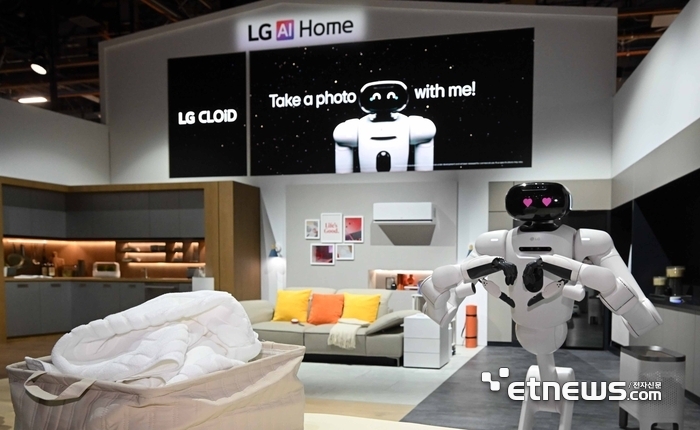









LG Electronics will deploy its household humanoid robot 'CLOiD' to factories first. This is a strategy to advance the commercialization timeline by using manufacturing sites as a bridgehead, instead of home environments which carry institutional burdens and require high completeness.
LG Electronics is considering deploying CLOiD to domestic manufacturing processes as early as the end of this year. It is reported that the company will expand Proof of Concept (POC) by applying it to logistics tasks such as material handling, rather than complex processes. This is a move to accumulate real-world data at manufacturing sites by bypassing the form factor limitations and regulatory burdens unique to household robots.
Ryu Jae-cheol, chief executive officer of LG Electronics, revealed plans to verify home robot commercialization at CES in January this year, saying, “CLOiD will likely leave the lab and be seen in the field around 2027.” The deployment to manufacturing sites is interpreted as an effort to concretize such plans ahead of schedule. An industry insider said, “Applying CLOiD to LG Electronics' manufacturing processes first is a natural step.”
LG Electronics is speeding up the construction of validation infrastructure for CLOiD. Since last month, the company has been transforming the Yangjae R&D Campus in Seocho-gu, Seoul--which spans a total of four floors from the first basement floor to the third ground floor, with a total floor area of 10,000 pyeong--into a Robot Data Factory.
The company plans to deploy 100 CLOiDs starting next month and expand the number to several hundred within the year. By creating the environment necessary for robot operations, it will collect data specialized for CLOiD's home and factory environments. This is a preliminary task for deploying the robots into actual factories.
The deployment to manufacturing sites is interpreted as a core data acquisition strategy for the commercialization of home robots, going beyond mere validation. The repetitive and standardized working environment of industrial sites is optimal for advancing robot control algorithms and sensor data.
Verifying the actuator, a core component for driving robots, is also a major purpose. LG Electronics plans to complete the mass production system for its own robot actuator brand 'AXIUM' this year. The primary goals are securing cost competitiveness and stabilizing the supply chain through the in-house production of components. An industry insider said, “They will try to raise competitiveness to a level suitable for commercialization through field tests tailored to each situation.”
The industry predicts that the time CLOiD will enter the home robot market in earnest will be around 2030. A robot company official anticipated, “LG Electronics will need three to four years to introduce CLOiD into the household robot market,” adding, “Based on data accumulated in the manufacturing process, they will explore various possibilities, including form factor modifications.”