








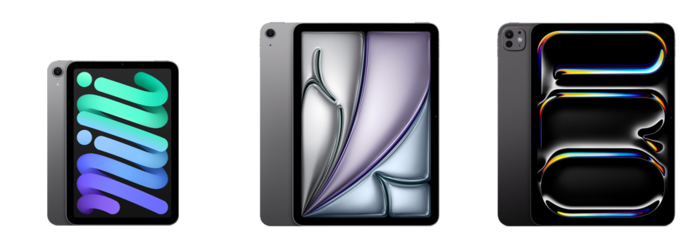
Samsung Display and LG Display started mass production of organic light-emitting diodes (OLEDs) to be loaded into Apple's strategic products and new products released in the second half of this year. As Apple's OLED-equipped product lineup has expanded further this year and China's BOE failed to enter, South Korean displays are scheduled to be entirely loaded, so the Apple special demand for Korean companies is expected to be even bigger.
According to the industry on June 22, the domestic display industry entered mass production of OLED panels for the iPhone 18 Pro, Pro Max, and iPad mini starting this month.
The mass production of foldable iPhone OLEDs also starts this month. MacBook Pro OLEDs will be produced starting next month when Samsung Display's 8.6-generation OLED line operates.
The OLEDs loaded into all products released in the second half of this year will be entirely supplied by Samsung Display and LG Display, the two representative display panel companies in South Korea.
For the Pro and Pro Max of the iPhone 18 series, Samsung Display and LG Display supply them together. It is known that BOE, a Chinese company, did not carry out a development project for the iPhone 18 series.
An industry official said, “As BOE suffered setbacks in supply due to quality issues even after receiving approval to supply OLEDs for the iPhone 17 Pro model last year and barely resumed supply in April, BOE did not step forward for development regarding the new iPhone models in the second half of this year.”
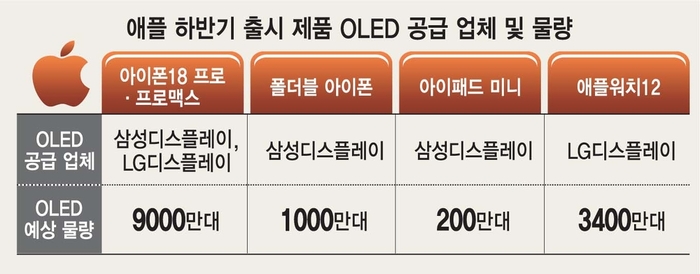
Apple releases a foldable iPhone for the first time this year and increased OLED-adopted product lineups by converting the iPad mini and MacBook Pro to OLEDs in information technology (IT) product groups such as tablets and monitors. For these products, Samsung Display alone supplies the displays. For the Apple Watch 12 OLED, LG Display is entirely in charge.
The monopolization of displays for Apple products, one of the world's largest IT manufacturers, by domestic companies is an achievement made by South Korea's OLED technology.
Apple is a company that actively promotes supplier diversification to strengthen price bargaining power and stabilize the supply chain. In displays particularly, it maintained a movement to lower the South Korean proportion by continuously adding Japanese and Chinese companies. However, as domestic display companies are ahead in terms of new technology, quality, and mass production, it is interpreted that Apple is expanding the supply proportion of South Korean-made OLEDs.
Apple is the largest customer of the domestic display industry. According to the Sustainability Report published by Samsung Display in 2025, the proportion of revenue generated from the US region, where Apple is located, reached 45.6%. According to the quarterly report of LG Display, the revenue proportion of a company presumed to be Apple was 58.4%.
