








The domestic pharmaceutical and biotech industry is expanding its use of artificial intelligence (AI). Beyond the stage of discovering new drug candidates, AI is now being applied to directly design drug molecules and predict disease progression. Its on-site utility is increasing, with applications even extending to validating the effectiveness of new drug clinical trials.
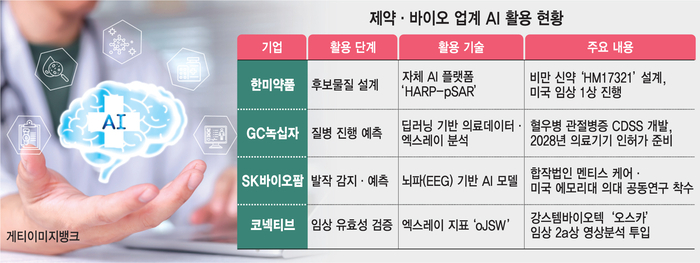
According to industry sources on the 2nd, Hanmi Pharmaceutical designed its obesity drug candidate 'HM17321' using its proprietary AI platform 'HARP-pSAR' and is currently conducting Phase 1 clinical trials in the U.S.
The company optimized the candidate substance by predicting protein sequence activity, such as amino acid residue positions, using only small-scale internal experimental data from dozens of cases. This approach has been praised for overcoming the limitation of “insufficient experimental data” in the early stages of drug development, thereby maximizing research efficiency.
GC Pharma is accelerating the development of disease progression prediction models. In collaboration with the Korea Hemophilia Foundation, the company is developing a clinical decision support system (CDSS) for hemophilia arthropathy. By analyzing 30 years of domestic patient medical data and over 3,000 X-ray images using deep learning, the system can predict joint conditions up to 20 years in advance.
A prototype is expected next year, with plans to obtain medical device approval by 2028. Upon commercialization, it is anticipated that personalized preventive therapies and treatment plans based on patient conditions will become possible, enabling proactive prevention of severe joint damage.

SK Biopharmaceuticals has integrated AI with electroencephalography (EEG). Through its joint venture Mentis Care, the company has commenced collaborative research with Emory University School of Medicine in the U.S. to develop an AI model for real-time detection and prediction of epileptic seizures. The goal is to establish a diagnostic ecosystem that connects hospital equipment with wearable devices.
This approach aims to preemptively detect sudden seizure risks to prevent secondary accidents and significantly enhance the accuracy of epilepsy treatment and management through continuous monitoring in daily life.
AI image analysis technology has also been introduced into the clinical validation process for new drugs. Conective, a medical AI company, signed a contract with Kangstem Biotech to analyze imaging data for the osteoarthritis stem cell therapy 'Oska' in its Phase 2a clinical trial. Conective will apply its X-ray indicator 'oJSW (minimum joint space width)' to quantify cartilage regeneration effects by identifying the narrowest gap between knee bones using deep learning. This marks the first instance where such an indicator is used in new drug clinical trials. Conective has completed verification using data from the U.S. National Institutes of Health (NIH) and is working to establish clinical judgment criteria.
While these cases differ in the data utilized—such as compound sequences, X-rays, and EEGs—they share a common focus on clinical or actual treatment applications. Beyond virtual data screening, AI's scope is expanding across the pharmaceutical and biotech value chain.
For AI adoption to further spread in the pharmaceutical and biotech industries, it must overcome clinical validation and regulatory hurdles. Both predictive models and imaging indicators require proof of accuracy in real patients, and medical device approval processes by regulatory agencies like the Ministry of Food and Drug Safety (MFDS) are necessary for full-scale implementation in healthcare settings.
A medical industry insider stated, “While there are barriers to widespread adoption, AI offers the advantage of reducing research costs and minimizing trial-and-error by segmenting new drug clinical trials and disease stages. Once fully utilized, it will accelerate drug launches and serve as a key tool for providing personalized treatment options.”
