








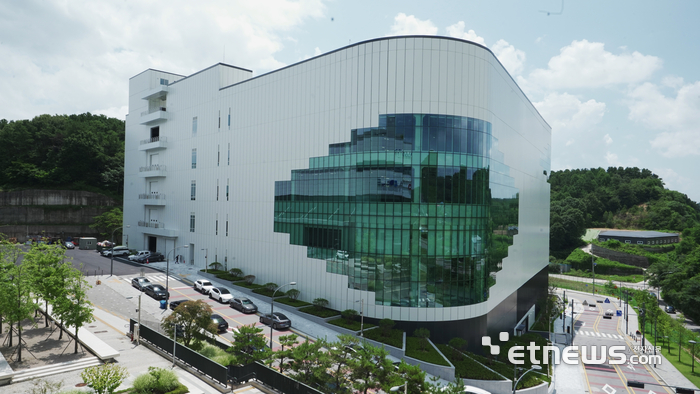
The world's largest permanent marketplace specializing in used equipment and parts will open in Yongin, a core hub of the K-Semiconductor Belt.
The practice of inquiring individually with multiple companies to revive semiconductor equipment stopped because a single part could not be found is expected to disappear.
According to industry sources on Aug. 2, Surplus Global, a semiconductor equipment and parts trading company, has completed the completion approval process for a new 13,000-pyeong (approx. 42,975 square meters) facility built in Cheoin-gu, Yongin-si.
An entire floor will be designed as a space to display and trade semiconductor parts, while the remaining space will house used equipment moved from the existing equipment cluster, with the official opening scheduled for next month.
It is the world's largest in scale for a format where multiple equipment and parts companies maintain permanent shops to display physical inventory and conduct trades.
The company will also expand its offline parts mall and strengthen its online platform, “SemiMarket.” Currently, about 60,000 semiconductor parts are registered and operated, and through the relocation to the Building B parts mall, the company plans to expand the scale to 100,000 items by the end of this year.
Trading methods will also undergo a major transition. Previously, Surplus Global developed its business in the form of directly purchasing equipment and parts and reselling them. As SemiMarket grows in earnest, services where semiconductor manufacturers and equipment and parts companies enter directly as sellers to trade products are expanding. Currently, about 100 companies have registered as sellers on SemiMarket.
The parts mall is expected to ease procurement difficulties for legacy semiconductor parts, including 8-inch fabs. Old equipment is still used at semiconductor production sites, but it is difficult to secure necessary parts on time due to discontinuation and reduced maintenance support from original manufacturers. Even if a single part cannot be obtained, equipment can stop, causing losses across the entire production line.
Surplus Global plans to rapidly expand its parts business, which is currently under KRW10 billion, based on the parts mall and SemiMarket.
“Our goal is to grow the parts business to KRW150 billion in revenue by 2030,” Kim Jung-woong, Surplus Global CEO, said.
The company also provides a harvest service that dismantles end-of-use equipment to recycle parts, and a refurbish service that restores the performance of aging equipment. It plans to build a circular ecosystem that extends the lifespan of semiconductor equipment by linking parts supply and repair services.
The existing 21,000-pyeong facility, Building A, which serves as a large-scale equipment cluster, will expand its cleanrooms to focus on high-value-added businesses. The company plans to expand its equipment upcycling business, which modifies used equipment to fit client processes and specifications while enhancing performance.
“We have invested tens of billions of won in the upcycling business and have almost completed technology development,” Kim said. “Starting this year, we expect related results to materialize by selling multiple units of equipment.”
Surplus Global plans to nurture the Yongin facility as a hub for global used semiconductor equipment and parts trading. Once the Yongin model settles, it will consider applying the online-and-offline combined equipment cluster and parts mall model to major semiconductor regions such as the U.S. and Taiwan.
