








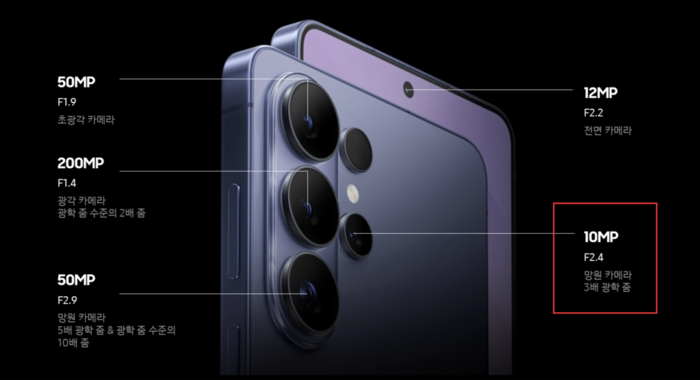
Samsung Electronics will equip three rear cameras on all models of the Galaxy S27 series scheduled for release next year. The Ultra model, which previously carried four cameras, will have its camera count reduced by one.
This move is interpreted as a strategic response to surging prices of semiconductors and components. It is an attempt to stabilize the prices of the Galaxy S27 series by reducing the number of components in the Ultra model, which sells the most.
According to industry sources on Aug. 2, Samsung Electronics has shared these details with its Galaxy S27 camera supply partners.
The key change is that the rear cameras on the Ultra model will be reduced from four to three. The 10-megapixel 3x optical zoom telephoto camera, which was included previously, will be removed, while the 50-megapixel 5x optical zoom folded camera will be retained.
Instead, the newly introducing Galaxy S27 Pro next year is slated to feature a 12-megapixel 3x optical zoom telephoto camera.
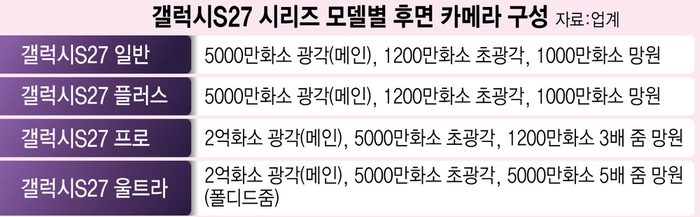
Specifically, the S27 Pro rear camera setup consists of a 200-megapixel main camera, a 50-megapixel ultra-wide camera, and a 12-megapixel 3x optical zoom telephoto camera. The S27 Ultra features a 200-megapixel main camera, a 50-megapixel ultra-wide camera, and a 50-megapixel 5x optical zoom folded camera.
The rear cameras for the Galaxy S27 Pro and Ultra will be supplied by Samsung Electronics, Samsung Electro-Mechanics, Namuga, Partron, Power Logics, and China's Sunny Optical, among others.
Such actions are analyzed as an effort to counter “chipflation” by adjusting the number of cameras to reduce manufacturing costs. As memory semiconductor prices rise significantly, price pressures on other components, including cameras, are also intensifying. For this reason, the plan is to cut costs by reducing one camera from the best-selling model.
The Ultra model is the highest-selling model among the Galaxy S series. According to Counterpoint Research, the Ultra accounted for 46% of the Galaxy S25 series sold in the global market last year.
“Cameras have reached a point where image quality is technically saturated,” an electronic components industry official said. “Given the severe pressure on manufacturing costs, it appears this decision was made to cut costs.”
