







TSMC is expanding its outsourcing of a key process used to package artificial intelligence (AI) chips, a move seen as an effort to ease manufacturing bottlenecks in the AI semiconductor supply chain. A substantial share of the volume previously handled by TSMC is expected to shift to outsourced semiconductor assembly and test (OSAT) providers, potentially triggering major capital investment across the sector.
According to industry sources on Aug. 4, TSMC has decided to further outsource the chip-on-wafer (CoW) packaging stage of its CoWoS advanced packaging process to OSAT companies including ASE. Major OSAT providers are reportedly placing equipment orders to build new production lines, while also holding purchase-order discussions with South Korean materials, components and equipment suppliers.
Although the scale of investment has not been disclosed, the companies are expected to significantly expand production capacity from current levels.
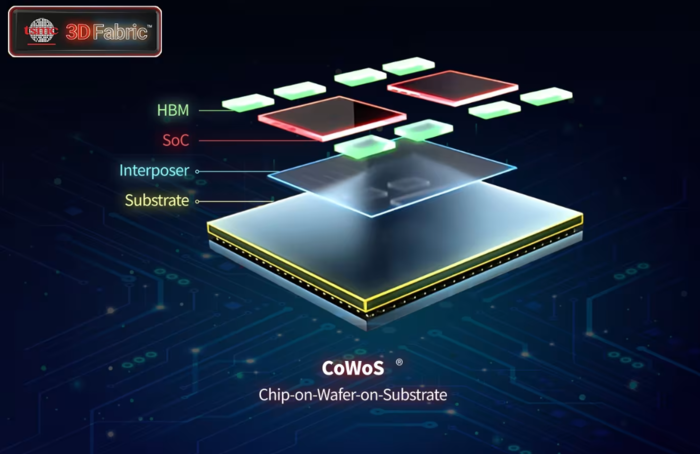
CoWoS, short for Chip-on-Wafer-on-Substrate, is TSMC's 2.5D advanced packaging technology used to manufacture AI chips. It integrates AI processors such as graphics processing units (GPUs) and system-on-chips (SoCs) with high-bandwidth memory (HBM) stacks arranged around them. An interposer—an intermediate substrate—connects the processor and memory components.
TSMC refers to the process of attaching chips to an interposer as CoW, while the subsequent process of bonding the interposer to the package substrate is known as wafer-on-substrate (WoS).
Until now, TSMC has mainly outsourced the WoS stage. Companies including ASE, Amkor and SPIL have produced these packages under technology licenses from TSMC. While some CoW volume had also been outsourced, the scale was believed to be limited.
The decision to sharply expand CoW outsourcing is widely viewed as a response to persistent bottlenecks in AI chip manufacturing. Demand has surged not only from global fabless chip developers led by Nvidia, but also from AI data-center operators developing and deploying their own custom chips.
TSMC is estimated to account for roughly 90% of the global market for AI semiconductor manufacturing. However, demand continues to outpace the company's in-house production capacity, prompting it to increase outsourcing.
“TSMC has continued to invest in packaging equipment for AI chip production, but advanced packaging remains a bottleneck,” an industry source said. “With market demand continuing to grow, this outsourcing expansion appears to be an effort to increase capacity alongside key OSAT partners.”
As OSAT companies receiving CoW orders from TSMC ramp up capital spending, suppliers of back-end semiconductor materials, components and equipment are also expected to benefit. Investment is likely to focus on dicing processes for cutting wafers and interposers, as well as bonding processes used to join wafers and interposers.
According to multiple South Korean semiconductor-equipment industry sources, discussions are under way to supply CoW-related equipment for laser processing and bonding.
