








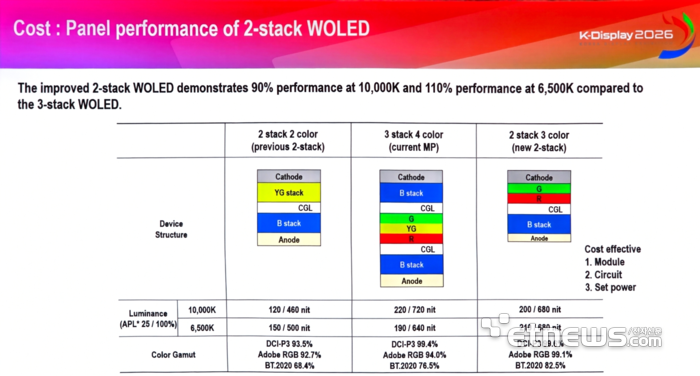
LG Display has developed a two-stack white OLED (WOLED) technology that uses fewer organic light-emitting layers than conventional designs and is now considering its adoption. The company expects the approach to improve cost competitiveness and support broader adoption of large OLED displays.
According to industry sources on Aug. 2, LG Display's two-stack WOLED technology lowers driving voltage by more than 4V compared with its conventional three-stack WOLED panels, while maintaining similar performance in key areas such as brightness and color gamut.
At a recent display business forum, Kim Jung-geun, a research fellow at LG Display, said the company had achieved brightness and color temperature comparable to those of three-stack panels despite substantially lower driving voltage. He added that the technology delivered even better color-gamut results in some tests.
Tandem OLED technology stacks multiple organic light-emitting layers to improve brightness, lifespan, and durability. It has therefore become a key technology for OLED panels.
Its use is expanding not only in WOLED and quantum dot OLED (QD-OLED) panels for TVs and monitors, which are produced without a fine metal mask (FMM), but also in red-green-blue (RGB) OLED panels used in automotive displays, IT devices, and smartphones.
LG Display produces large OLED panels using a WOLED architecture, in which white light is generated first and then converted into different colors through color filters. Its first-, second-, and third-generation WOLED panels used a three-layer blue-yellow-blue tandem structure to create white light.
Starting with the fourth-generation panels introduced last year, LG Display adopted a four-layer blue-green-blue-red structure. The company currently manufactures panels based on both three-layer and four-layer architectures.
The two-stack WOLED approach marks a shift from the industry's conventional strategy of adding more emitting layers to improve brightness and lifetime. Instead, it reduces the number of organic layers to lower manufacturing costs.
Stacking multiple light-emitting layers distributes energy across individual OLED elements, helping extend panel life. However, it also increases the amount of OLED material required and raises process complexity and manufacturing costs.
The two-stack WOLED technology is viewed as one of several measures LG Display is pursuing to address price, widely regarded as the biggest obstacle to the broader adoption of large OLED panels. OLED TVs and monitors continue to face slower market penetration than LCD products because of their higher prices.
LG Display has already commercialized its entry-level WOLED Special Edition, or OLED SE, panel. The company is reported to have reduced manufacturing costs by around 20% compared with earlier products beginning this year.
However, OLED SE panels remain more expensive than LCD panels, highlighting the need for further cost reductions to expand the large OLED market.
“LG Display is focusing on making large OLED panels more widely accessible by lowering costs,” an industry source said. “Two-stack WOLED is one of the technologies being considered as part of that effort.”
