








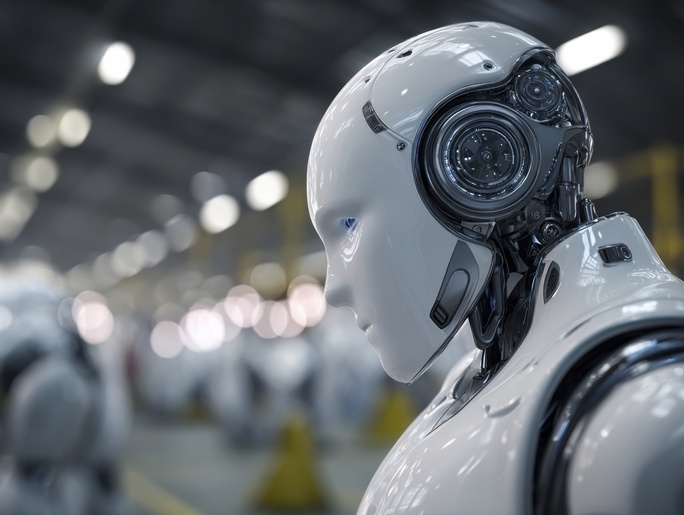
China is accelerating its efforts to commercialize humanoid robots by simultaneously pushing industry standardization and stimulating market demand. The move aims to shift humanoid robotics from a purely experimental lab phase to commercially ready products that can be deployed across industrial and service sectors.
According to Reuters on June 22, China's Ministry of Commerce recently unveiled 17 measures designed to integrate artificial intelligence (AI) into the consumer goods and services sectors.
These initiatives focus on expanding AI adoption in both households and businesses. In the consumer goods sector, the policy emphasizes upgrading home appliances and consumer products into intelligent devices while fostering a new market for humanoid robots.
By incorporating smart appliances, consumer goods, humanoid robots, and the automation of public and lifestyle services into its AI expansion strategy, the ministry's latest measures signal a clear policy shift. China intends to extend the role of humanoid robots well beyond manufacturing, pushing them deeper into consumer-facing and service industries.
In parallel with this market push, China's Ministry of Industry and Information Technology (MIIT) recently announced its third batch of industrial standard-setting and revision projects, designating humanoid robotics as a core area for standardization.
The initiative aims to establish unified standards for humanoid robot data collection, dedicated data acquisition systems, general technical requirements, multi-fingered robotic hands, and end-effector interfaces.
Industry analysts view this as a strategic move to shift humanoid robots from a phase of prototype competition among individual companies to a scalable, mass-production ecosystem. To ensure that robots can be seamlessly deployed in real-world environments, China is restructuring component and data specifications while broadening applications across manufacturing, logistics, retail, and lifestyle services.
For humanoid robots to effectively penetrate consumer and service markets, universal specifications that can adapt to diverse operating environments are essential. Because functional requirements vary significantly across restaurants, retail stores, logistics centers, hospitals, nursing facilities, and public service venues, standardization of hands, end-effectors, joints, and data interfaces is critical. Such standards will facilitate easy component replacement and enable the efficient reuse and sharing of operational data.
Reuters notes that China's latest measures are aimed at extending the reach of AI and robotics from retail into public and everyday services. Chinese policymakers reportedly view high labor costs and low levels of standardization as key bottlenecks holding back the growth of service consumption, and they intend to address these constraints through the aggressive adoption of AI and robotics.
