








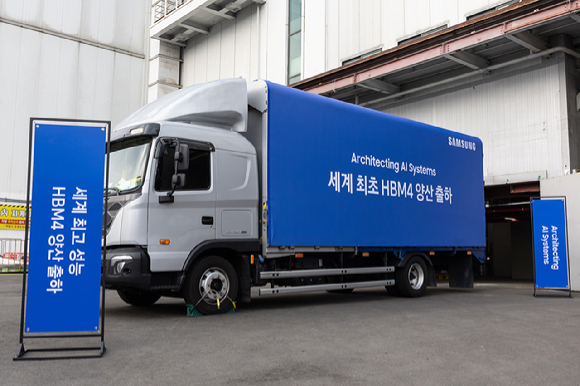
Samsung Electronics' 6th-generation High Bandwidth Memory (HBM4) has surpassed $1 billion (approximately 1.54 trillion won) in sales in about 130 days since mass production last February. Achieving $10 billion in sales within the year is also expected.
In line with this, Lee Jae-yong, chairman of Samsung Electronics, also personally visited the Cheonan plant in South Chungcheong Province, an HBM production base, to check production and quality competitiveness, giving weight to business expansion.
According to the industry on the 23rd, Samsung Electronics recently recorded such performance as demand for HBM4 surged. Considering the trend, cumulative sales at the end of June are expected to be $1.2 billion, and more than $10 billion on a year-end basis.
HBM is a memory that helps AI semiconductors send and receive vast amounts of data quickly. Demand surged as major global big tech companies, such as Nvidia, adopted it for their own AI chips. In particular, the market size grew dozens of times due to the explosion in demand for Nvidia's 'Blackwell' and 'Rubin'. The supply price of HBM3, a 4th-generation product, has risen more than several times now compared to the time of mass production in 2022.
Samsung Electronics succeeded in mass-producing HBM4, which corresponds to the 6th generation, for the first time in the world on February 12. Through the bold choice of applying a 4-nanometer advanced process to the base die of the memory, it secured a competitive advantage in terms of performance and mass production stability.
Samsung Electronics HBM4 secured a data processing speed (11.7Gbps) that is about 46% faster than the industry standard, resolving the 'data bottleneck' that worsens as AI model performance is enhanced. Data transmission capability was increased by 2.7 times compared to the predecessor, and power efficiency was improved by 40%. From the perspective of data centers, power and cooling burdens can be reduced, allowing them to catch two rabbits: performance and operating expenses.
Samsung Electronics continuously receives requests for HBM supply cooperation from major graphics processing unit (GPU) companies and application-specific integrated circuit (ASIC)-based hyperscaler customers. Backed by the expansion of the customer base, Samsung Electronics' HBM sales this year are projected to increase more than three times compared to last year.
Following HBM4, Samsung Electronics plans to preempt the market based on technological superiority in the next generations, HBM4E and HBM5. From HBM4E and HBM5, logic base die design capabilities and process competitiveness are expected to become more important than simple DRAM stacking technology.
Samsung Electronics, as an integrated device manufacturer (IDM), possesses all logic, memory, foundry, and packaging sectors. It is also a strength that it can flexibly respond to customer demand through synergy in each field. Lee, chairman, visiting the Cheonan plant on this day and personally checking the production site was also to further strengthen this competitiveness.
The HBM market growth trend is projected to be solid for the time being under the influence of the 'AI supercycle'. Bank of America (BofA) expected this year's HBM market size to grow 58% year-on-year to $54.6 billion. The World Semiconductor Trade Statistics (WSTS) forecast that the overall semiconductor market size would approach $1 trillion at $975 billion this year.
The diversification of HBM demand patterns from general-purpose GPU-centered to proprietary ASICs is also an opportunity factor for Samsung Electronics. Goldman Sachs projected that HBM demand for ASIC-based AI chips would surge 82% within the year, accounting for one-third of the total market.
