






Demand for Organic Light-Emitting Diode (OLED) monitors is surging, particularly in the premium segment, a trend that is set to heavily benefit South Korean display manufacturers, which effectively control the global supply of OLED monitor panels.
According to market research firm Omdia on June 23, the global OLED monitor market grew 74.2% in revenue terms, jumping from $1.59 billion in 2022 to $2.78 billion last year. The market is projected to expand a further 29.3% this year, reaching an estimated $3.59 billion.
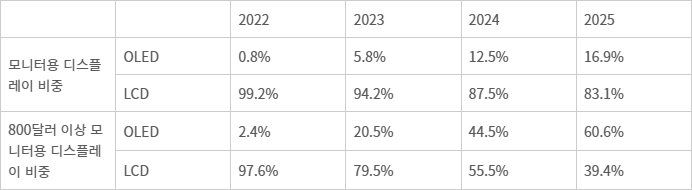
OLED's share of overall monitor revenue has climbed rapidly, rising from just 0.8% in 2022 to 16.9% last year. The shift is even more pronounced in the premium bracket--monitors priced at $800 and above--where OLED's market share soared from 2.4% to 60.6% over the same period, now accounting for more than half of the high-end monitor market.
Rapid adoption in the high-end segment is being driven by OLED's self-emissive pixels, which deliver near-infinite contrast ratios and highly immersive viewing experiences. In addition, the absence of a bulky backlight enables ultra-fast response times, making OLED the panel of choice in the lucrative gaming monitor sector, where speed is paramount.
“In the large-format segment, monitor panels offer higher profit margins and sharper growth trajectories than television panels, making them a primary strategic target,” an industry insider noted. “While overall market penetration is still at an early stage, Korean manufacturers are aggressively expanding shipments to secure dominance in this high-value segment.”
At present, the OLED monitor panel market is effectively a duopoly split entirely between Samsung Display and LG Display, which hold revenue shares of 74.5% and 25.5%, respectively. Unlike the mobile OLED sector, where Chinese rivals have rapidly gained ground, the large-format OLED market--covering TVs and monitors--remains a stronghold for South Korean firms.2 Both companies are now stepping up their strategies to cement this lead.
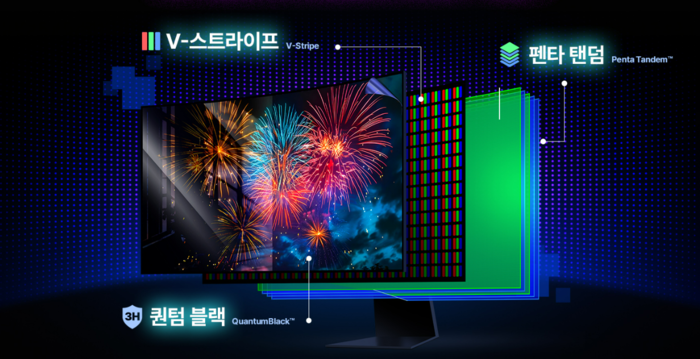
Samsung Display has developed “Quantum Black,” an anti-reflective, high-durability film that will be applied across all of its new monitor lineups this year. The company is also expanding its proprietary QD-OLED “Penta Tandem” technology--a five-layer blue light-emitting structure. First introduced in 27-inch displays, this architecture is being scaled up to 31.5-inch and 34-inch monitors this year, with plans to roll it out to 49-inch ultra-wide models in the second half.
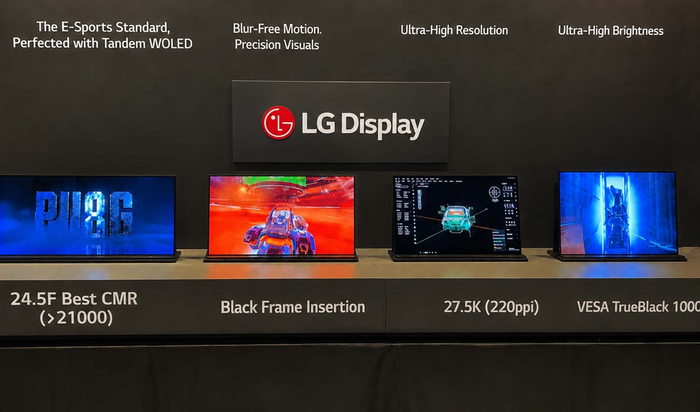
Meanwhile, LG Display aims to roughly double the share of monitor panels within its total large-format OLED shipments, targeting around 20% this year, up from the low-10% range last year. The company has been applying its fourth-generation large OLED technology--which uses a quad-stack of independent red, green, and blue (RGB) emitting layers--to monitors since last year. To further push performance boundaries, LG is also preparing next-generation features, including Black Frame Insertion (BFI) for motion-blur reduction and “True Black 1000” capabilities that deliver peak brightness of up to 2,000 nits.