








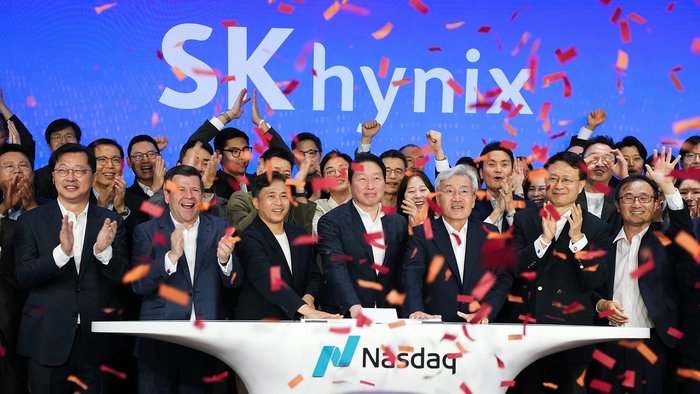
SK hynix has successfully listed American Depositary Receipts (ADRs) on the US Nasdaq, raising expectations for a re-evaluation of its domestic stock price.
On the 10th (local time), the first trading day, the ADR closed at $168.01, up 12.8% from the issue price, and demand was oversubscribed by more than seven times the supply volume. The size of the listing is $26.5 billion (about 40 trillion KRW), the largest in US market history for a foreign company.
This listing is significant in that it has secured direct accessibility to US institutional investors and provided an opportunity for a re-evaluation.
SK hynix occupies a 56-58% share in the global High Bandwidth Memory (HBM) market, establishing itself as a major supplier to Nvidia. However, many pointed out that its valuation in the global market did not properly reflect reality.
The company stated in its registration statement that the undervaluation of domestic companies stems from structural differences between domestic and foreign capital markets, explaining that the ADR listing could alleviate the valuation gap.
In the first quarter of this year, SK hynix recorded revenue of 52.58 trillion KRW and an operating profit of 37.61 trillion KRW, increasing by more than 198% and 400% respectively compared to the same period last year. As the ADR listing proceeded on top of this financial performance foundation, expectations grew that the valuation gap compared to Micron would shrink in part.
Previously, HSBC applied a 20% premium to the existing Price-to-Book (P/B) ratio of SK hynix in a June report reflecting the ADR listing. HSBC pointed out US investor accessibility and shareholder-friendly policies as the main reasons Micron maintained an average 35% premium over SK hynix for the past 13 years, and evaluated that the ADR listing will reduce this structural gap.
In the short term, expectations of US institutional liquidity inflow following the regular trading of ADRs starting on the 13th are projected to act positively.
In the medium to long term, the usage of the raised funds is a key variable. The funds, worth about 40 trillion KRW, will be injected into expanding domestic production capacity, such as building the first fab of the Yongin Semiconductor Cluster, advanced packaging facilities in Cheongju, and purchasing ASML Extreme Ultraviolet (EUV) equipment. This is projected to become a foundation to further solidify its HBM market dominance.
Kwak Noh-jung, president and CEO of SK hynix, stated on the day of the listing, “2027 will be the most difficult year in industry history from a supply perspective,” which is evaluated as highly likely to lead to HBM price increases and margin improvements. Already, most of the production volume for 2026 is completely sold out.
Chey Tae-won, chairman of SK Group, also predicted, “Currently, the speed of (memory) demand growth is far outstripping supply expansion, so this trend will continue for a considerable period.” Chey also emphasized, “Customers are requesting far more memory than expected,” adding, “If supply expansion is delayed, not only AI but also other industries such as automotive and consumer goods could face difficulties, so we must increase production capacity as quickly as possible.”
Meanwhile, as SK hynix plans to use most of the ADR funds for domestic investment, the possibility of exchange rate stabilization due to a large-scale dollar inflow is also drawing attention. This is because the scale of the dollar flowing in this time is of a 'currency swap level' size. Out of the $60 billion currency swap signed between the Bank of Korea and the US Federal Reserve (Fed) during COVID-19 in 2020, the actual dollar supplied to the domestic market totaled $19.872 billion.
