








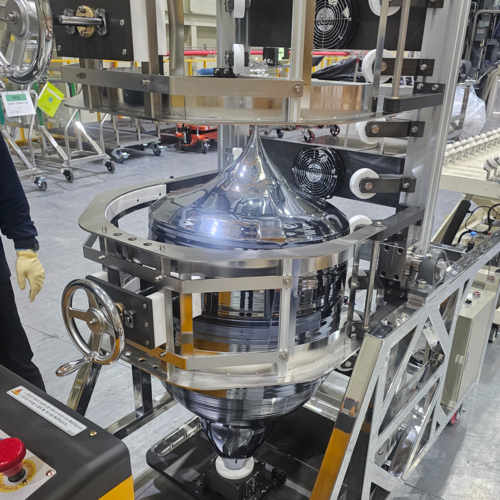
CMTX, a semiconductor silicon materials and components specialist, has successfully developed an ultra-large 600mm single-crystal silicon ingot and is now moving into full-scale production of both the material and related components--marking a world-first achievement in the aftermarket segment, where parts are supplied directly rather than through equipment makers.
CMTX announced on July 19 that its subsidiary Cellic has successfully developed the technology to grow 600mm single-crystal silicon ingots.
Silicon ingots serve as the core material for semiconductor wafers and are also used to make consumable components used in etching processes. CMTX's core products include electrodes (also called showerheads)--made by horizontally slicing the ingot and drilling fine gas holes into it--and silicon rings, which surround wafers to control plasma during processing. The company supplies these components to roughly 20 fabs worldwide, including major memory makers and foundries.
Larger-diameter electrodes improve both productivity and yield stability for semiconductor wafers, since they allow more wafers to be processed simultaneously or support larger wafer sizes to boost output. Single-crystal electrodes also offer a key advantage over polycrystalline versions: they generate virtually no impurities or particles and deliver more uniform electrical and thermal properties.
Impurities or particles introduced during etching often force manufacturers to scrap entire wafers, making them a serious threat to yield management. That's why high-quality electrodes that combine single-crystal structure with large diameter are in high demand for next-generation, leading-edge semiconductor processes.
CMTX has built a vertically integrated system spanning everything from raw material production to component processing and supply. The company produces more than 95% of its materials in-house, and its focus on upstream R&D has been key to breaking into leading-edge process applications. Building on this foundation, CMTX aims to lead the high-value single-crystal silicon market.
The company's precision gas-hole machining technology is considered world-class. It can drill roughly 2,000 gas holes into a silicon electrode with diameter variation held within 15 micrometers. CMTX also offers high-flatness processing (under 10 micrometers), precision curved-surface machining, and specialized surface treatment. Its automated etching and cleaning systems, along with automated particle measurement, are also unique within the aftermarket industry.
The company is also diversifying its product lineup. It has built an in-house processing and cleaning line for quartz components--parts used to protect wafers and equipment during high-temperature chemical processes such as etching and deposition--allowing it to respond quickly to demand from global semiconductor and equipment makers. CMTX also plans to establish a production line for CVD-SiC (chemical vapor deposition silicon carbide) components by the first half of 2027.
In addition, the company is developing next-generation technologies including high-durability hybrid materials and components for large-scale etching chambers. With a new plant at its Gumi M Campus--backed by a 60 billion KRW investment--CMTX plans to more than double its production capacity next year.
CMTX says it will continue to prioritize a technology-driven management approach, redefining quality (yield improvement), delivery (mass production stability and automation), and price (cost competitiveness through vertical integration) as the three pillars that prove its technical capabilities. The company's philosophy treats technology not as abstract R&D, but as a practical tool for delivering business results.
“Our goal is to grow our subsidiary Cellic into a company with world-class technology in ingot growth, both domestically and internationally,” said Park Jong-hwa, co-CEO of CMTX. “Beyond silicon, we also plan to build technical capabilities in growing specialized materials needed for aerospace and defense applications.”
