








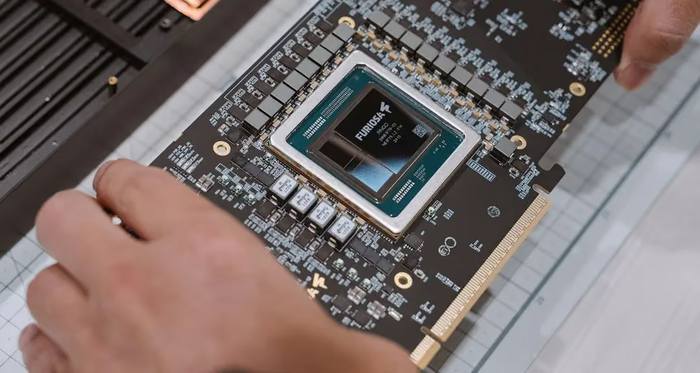
Domestic artificial intelligence (AI) semiconductor startup FuriosaAI has officially entered a mass production system for chips specialized in Large Language Model (LLM) inference. Attention is focused on whether domestic AI semiconductors, featuring “cost-effectiveness” and “power efficiency,” will break through in the AI semiconductor chip market dominated by Nvidia.
According to the industry on the 13th, FuriosaAI will significantly expand the production volume of its second-generation LLM inference-specialized chip, “Renegade (RNGD),” to 40,000 to 50,000 units by next year. This is a scale increased by more than double compared to 20,000 units this year. This is the first time that the next year's production plan of FuriosaAI, a leading domestic AI semiconductor company, has been identified.
The rapid change in the AI market is the background behind the production expansion. Recently, as “agentic AI,” which judges and works on its own without user intervention, has spread, the demand for inference operations that repeatedly call semiconductor chips has grown. In addition, as the power consumed by AI infrastructure increases, “performance relative to power” has also emerged as the core of chip competitiveness.
Renegade, designed specialized for inference functions, delivers performance similar to overseas high-performance GPUs with a power level of 200W. Since it can actually generate more than twice the tokens under the same power conditions, it can reduce AI data center total cost of ownership (TCO) by nearly half. Analysis indicates that this cost reduction effect is driving purchase demand from large customers.
The introduction of Renegade is also being actively promoted in the domestic market. After completing performance verification with the “EXAONE” model developed by LG AI Research and at Samsung SDS, it is scheduled to be loaded into actual services and subscription-based clouds. As real demand increases, the plan to expand the production of Renegade has also been brought forward.
It is reported that FuriosaAI is establishing a mid-to-long-term research and development (R&D) investment plan worth trillions of KRW (including the National Growth Fund) to closely pursue the leaders in AI semiconductor chips in the future. A significant portion of the investment amount will be injected into the third-generation “Stoke” chip based on 2-nanometer (nm).
In particular, the third-generation Stoke chip joined hands with Broadcom, a global leader in communication semiconductors, to implement ultra-high-speed data transmission between chips. This is to overcome the “NVLink” barrier led by Nvidia. The company plans to integrate Broadcom's high-speed Ethernet-based Chip-to-Chip link technology, conceiving a strategy to overcome Nvidia's technical closedness with an all-in-one design.
An official at the company said, “In the past, there were many cases where semiconductor companies failed from a market expansion perspective even after securing good technology,” adding, “We will leap forward as a global AI semiconductor company by putting mass production stabilization and chip supply continuity at the forefront.”
