








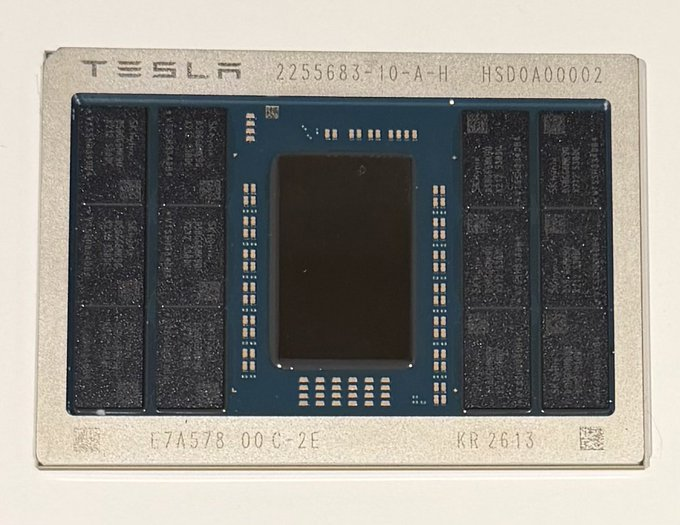
Samsung Electronics has completed the tape-out process, the final preparation stage for manufacturing Tesla's next-generation artificial intelligence (AI) semiconductor, the “AI5” chip.
According to the industry on the 13th, Samsung Electronics completed the tape-out for the AI5 chip, a stage where a fabless company typically transfers the finalized design data to a foundry. This achievement is a manufacturing-side completion, distinguished from the design tape-out announced by Tesla in April, and is expected to serve as an opportunity to reaffirm Samsung's 2-nanometer (nm) process technology and cooperative capabilities.
Samsung Electronics signed a supply contract worth 16.5 billion USD (approximately 22.7 trillion KRW) with Tesla last year, and the AI5 will be co-produced with TSMC. The AI5 is a core chip to be integrated into Tesla's Full Self-Driving (FSD), Optimus robots, and data centers, and its computing performance is known to be significantly enhanced compared to the AI4.
Currently, Samsung is mass-producing the AI4 using a 7-nm process at its Pyeongtaek plant, and the 2-nm line at the Taylor plant is expected to become the flagship production base for the AI5 and AI6.
The Taylor plant is a North American semiconductor production hub being constructed by Samsung Electronics with an investment of 17 billion USD. Starting with initial operations at the end of this year, it is scheduled to enter full-scale mass production of Tesla volumes next year. Industry observers believe that the completion of this tape-out will accelerate preparations for the operation of the Taylor plant.
This achievement is expected to provide momentum for earnings improvement in Samsung's foundry business, which has continued to log deficits. While its mid-to-long-term order backlog is nearing 50 trillion KRW, the company continues to secure big tech customers such as Meta and Anthropic in addition to Tesla.
In particular, analysis indicates that if the stabilization of the 2-nm process yield and the early operation of the Taylor plant succeed, the company can strengthen its positioning in the competition against TSMC and drive the return of past customers.
