

Memory chip supply shortages affecting PC manufacturers are expected to ease next year.
Major PC manufacturers are pursuing a strategy of securing profitability by signing long-term agreements (LTAs) with memory manufacturers and expanding the supply of business-to-business (B2B) PCs, where demand remains relatively robust despite declining sales of business-to-consumer (B2C) PCs.
Major companies, including Lenovo, HP and Dell Technologies, have completed LTAs with memory manufacturers. This year, PC manufacturers struggled to secure sufficient semiconductor supplies as memory demand surged amid expanding investment in AI infrastructure. The agreements are intended to establish stable memory supply chains.
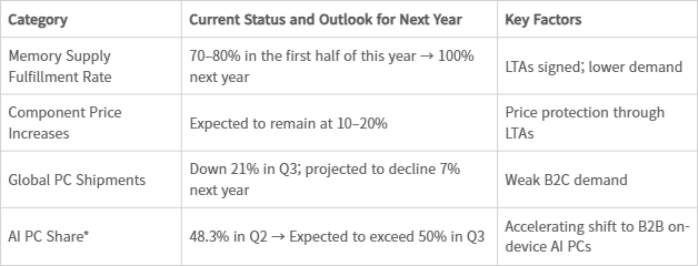
“In the first half of this year, memory supplies fell significantly, and we received only 70% to 80% of the DRAM and solid-state drives (SSDs) we requested,” a senior executive at a PC manufacturer said. “With the LTAs in place, we do not expect major procurement problems next year.”
Paradoxically, declining demand for consumer PCs due to product price increases driven by rising costs is also considered a major factor easing memory supply shortages. Reduced PC shipment volumes have lowered procurement pressures across major supply chains.
The pace of component price increases is also expected to slow next year compared with this year. Although DRAM and SSD prices are expected to continue rising next year, major PC manufacturers have been able to cushion the impact through LTAs. Taking into account price increases for central processing units (CPUs) and graphics processing units (GPUs), overall component prices are projected to rise by approximately 10% to 20% next year.
As a result, PC manufacturers are expected to gain some breathing room next year. Smoother memory procurement will improve production stability, while slower component price increases will help protect profitability.
However, sluggish demand for consumer PCs remains a risk. Rising PC retail prices and an economic slowdown have weakened consumer purchasing power, leading to expectations that the B2C PC market will recover slowly.
Market research firm Omdia said global PC shipments plunged 21% in the third quarter from a year earlier. The decline was attributed to falling sales volumes as average selling prices (ASPs) for PCs rose by double digits. Omdia also forecast that PC shipments would decline 7% next year.
Accordingly, PC manufacturers are shifting their business focus from B2C to B2B. Demand for B2B PCs has remained strong as companies seek to improve productivity through artificial intelligence (AI) adoption while replacing devices used by employees.
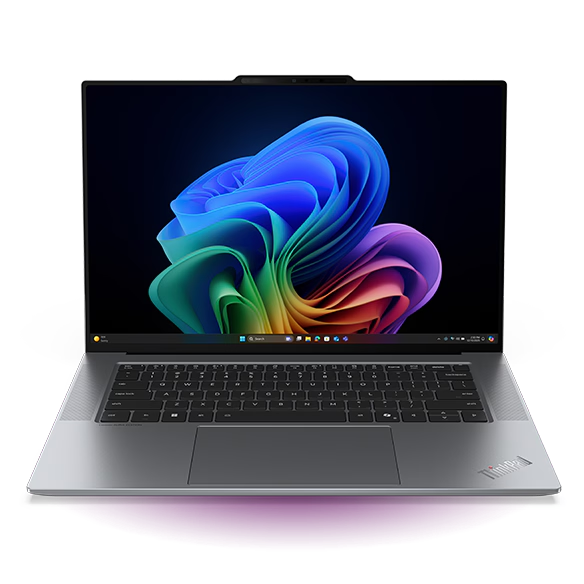
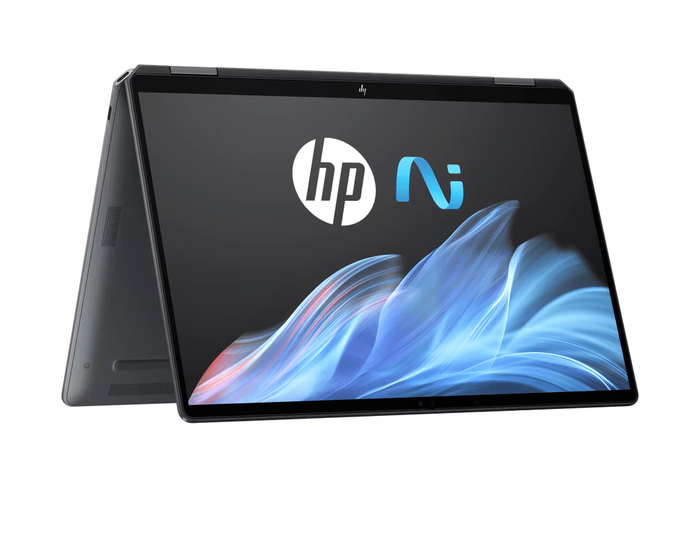
Driven by the expansion of AI, on-device AI PCs, which perform AI computations directly on desktops or laptops without connecting to the cloud, are experiencing growth.
According to Omdia, AI PCs accounted for 48.3% of total PC shipments in the United States in the second quarter, and their share is expected to exceed 50% in the third quarter. Shipments of premium PCs priced above $1,500, meanwhile, increased 36.8%.
“Despite weakness in the B2C PC market, demand for B2B AI PCs is expected to increase,” a PC industry official said. “Our business priorities for next year are to expand our AI PC lineup and increase supply based on more stable component procurement.”
PC Industry Overview and Key Indicators — U.S. Market Basis (Sources: Industry Data and Omdia)