








SAP has positioned the Autonomous Enterprise as the centerpiece of its business innovation strategy, envisioning an operating model in which AI agents are embedded across business processes, data, and governance. Under this model, AI can independently detect, analyze, and execute tasks, allowing employees to focus on strategic decision-making. By combining its enterprise resource planning (ERP) platform with its AI copilot, Joule, SAP aims to help businesses optimize operations and remain competitive in increasingly complex business environments.
At SAP NOW AI Tour Korea 2026, held on July 14 at the Grand InterContinental Seoul Parnas, SAP Korea unveiled its strategy for AI-driven innovation and enterprise transformation.
During the keynote address, Jan Bungert, Chief Revenue Officer for SAP Business AI Platform, outlined SAP's roadmap for building autonomous enterprises.
According to Bungert, an autonomous enterprise goes beyond simply recording business transactions. Powered by SAP's Autonomous Suite, AI agents connect finance, procurement, supply chain, human resources, and customer operations into a unified system that can manage day-to-day business activities, while employees concentrate on strategic decisions.
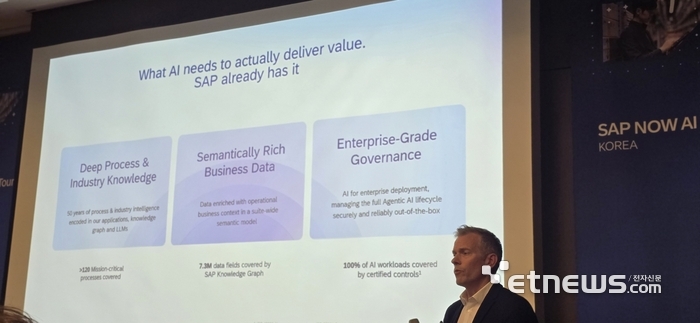
“For AI to generate real business value, it must be built on three essential pillars: deep process and industry expertise, rich business data, and enterprise-grade governance,” he said.
He identified three key components of the autonomous enterprise: Joule, which serves as a unified entry point for users; the SAP Autonomous Suite, which integrates enterprise-wide operations; and SAP Industry AI, which incorporates industry-specific regulations and business processes.
Bungert said SAP's key differentiator from general-purpose AI is accuracy.
“While general AI often provides plausible answers, SAP's Joule delivers trusted business insights by accurately reflecting enterprise ontologies through its Knowledge Core and Knowledge Graph,” he explained.
He added that, unlike competing solutions that require data to be moved across systems, SAP embeds data directly within business processes, enabling immediate and highly efficient execution without additional complexity.
Addressing concerns over AI reliability and the role of humans, Bungert emphasized SAP's “human-in-the-loop” strategy.
“AI agents are not designed to replace people--they are virtual colleagues,” he said. “While machines handle routine workflows, humans remain responsible for making informed decisions, ensuring AI operates within established guardrails, and focusing on strategic objectives.”
Bungert also noted that many AI initiatives fail because of weak governance.
“SAP embeds integrated governance and compliance across organizational silos directly into its AI agents, enabling companies to pursue business growth in a secure and well-governed environment,” he said.
The event also highlighted how SAP's AI vision is delivering tangible results for Korean manufacturers.
Park Jun-ho, Group Leader at Samsung Electro-Mechanics, shared the company's experience migrating to SAP S/4HANA based on SAP Premium Supplier standards to establish an AI innovation platform. By applying SAP's downtime optimization methodology, Samsung Electro-Mechanics reduced planned system downtime by 76%, from 144 hours to 34 hours, enabling a seamless business transformation without disrupting manufacturing operations.
“Despite having no domestic success stories to reference, we successfully improved manufacturing efficiency through extensive trial and error,” Park said. “Our goal is to build a closed-loop automation system that connects supply chain planning, ERP execution, AI analytics, and simulation.”
He added that the company has already seen tangible benefits from AI.
“In one case, Joule solved a problem in just one minute that even an expert with 20 years of experience had been unable to resolve, demonstrating AI's real potential to transform business operations.”
