






NVIDIA has begun shipping its next-generation AI platform, Vera Rubin.
According to Bloomberg and other media reports on July 21 (local time), NVIDIA has delivered Vera Rubin NVL72 racks to Google Cloud, Microsoft and Oracle Cloud. The systems are expected to begin running production AI workloads soon, marking the transition from testing to real-world deployment.
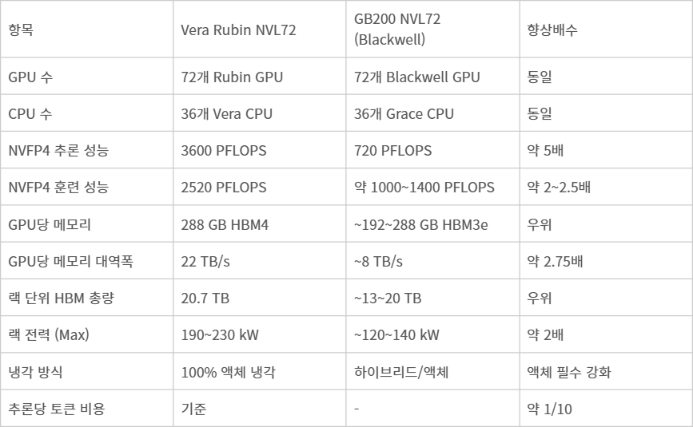
The Vera Rubin NVL72 is an AI supercomputer system that integrates 72 Rubin GPUs and 36 Vera CPUs into a single rack. Each Rubin GPU, built on TSMC's 3-nanometer process, contains 33.6 billion transistors and is equipped with 288 GB of HBM4 memory with memory bandwidth of 22 TB/s. Each rack delivers up to 3,600 PFLOPS of NVFP4 inference performance and 2,520 PFLOPS for AI training.
For the Vera Rubin rollout, NVIDIA replaced manual assembly with robotic manufacturing and adopted a cable-less design, reducing installation errors and cutting deployment time to tens of minutes. The changes are expected to improve data center operating efficiency significantly.
The large-scale rollout of Vera Rubin NVL72 is expected to drive strong demand for HBM4 memory. Each Rubin GPU is equipped with 288 GB of HBM4, bringing total HBM4 capacity to 20.7 TB per rack.
Industry analysts expect SK Hynix to account for the largest share of HBM supply, estimated at 60% to 70%. The company has maintained its leadership in the HBM3E market and has established the closest partnership with NVIDIA while demonstrating strengths in manufacturing capacity, yield and supply stability.
Samsung Electronics is also expected to secure a meaningful share of HBM4 production, reflecting its role in HBM4 technology validation and initial supply.
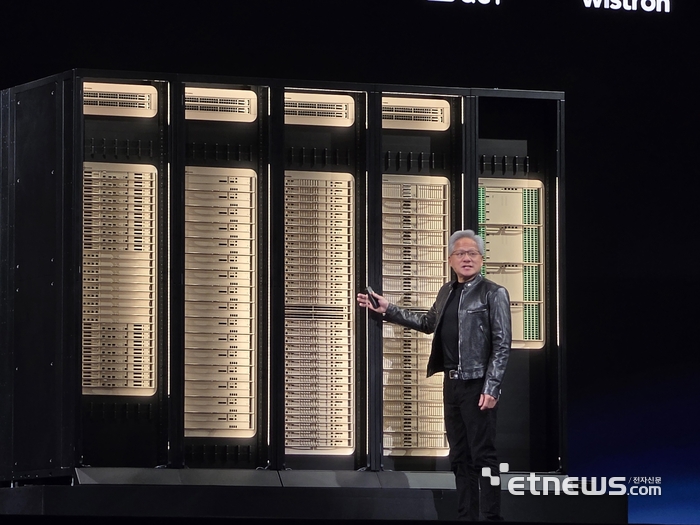
Vera Rubin is a rack-scale integrated platform in which GPUs, CPUs, HBM4 memory, NVLink 6 networking and storage are co-designed. Unlike conventional servers that allow individual GPU replacement, Vera Rubin requires installation of an entire dedicated rack. The platform also requires a 48U MGX rack together with advanced cooling infrastructure, including manifolds and coolant distribution units (CDUs).
Deployment in South Korea is expected to take longer because most domestic data centers rely on air cooling or hybrid cooling systems, making adoption difficult without major infrastructure upgrades. Only newly built or recently expanded high-density AI facilities are expected to be suitable for the platform.